By Darryl Wilkinson
This website brought to you in part by the following sponsor:

Find out how to advertise here - Email us! [email protected]

By Darryl Wilkinson
This website brought to you in part by the following sponsor:
Whadduyaknow about Gallatin’s CCC Camps during the Great Depression?
 To the best of my knowledge, these camp photos are being published for the first time. The late George Handley allowed me to make copies of his keepsake photographs although he knew little or no details or identifications other than the camp’s location north of Searcy R-5 Elementary School today.
Drilling down to local details describing Gallatin’s CCC camps remains a bit of a puzzle. Research continues.

This shows Gallatin Civilian Conservation Corps (CCC) Camp 730 as it stood in 1934. The camp was located west of Olive Street (south of today’s livestock auction barn) and entrance stoneworks can still be seen today on a private driveway along Olive Street. Another CCC camp operated in Dockery Park using tent structures.
One CCC camp operated at Dockery Park. A storm where lightning shocked one of the CCC boys made the news published by this newspaper in 1934. While the news item reported on the boy’s survival, it also offered a glimpse of the camp in general: “The wind did some damage at the camp, totally demolishing two of the 43 tents that are pitched there, and partially destroying five others.”

Gallatin’s CCC camp operated just like the military.
The CCC program was organized and operated like the military. There were eligibility requirements, enrollment procedures and allotment quotas. Throughout the country, each camp was organized for 250 young men but a camp was not usually made up of local men. Many campers here came from Oregon and Nebraska. Consider this news story published June 28, 1934:
“Daviess County was allotted a quota of 12 men for enrollment in the Gallatin CCC Camp 730, and at a meeting of the county relief committee and these men were selected from a list of some 150 applicants from over the county: Milton Moore, Wilbur Michaels, Paul Gott, James Ward, Isaac Swofford, Raymond Worrell, Loren Terry, Wendell Smith, John M. Ellis, Francis Wright, Gerald Sweany, Noland Williams…

Construction of the CCC barracks and campus was a project.
“Selections are required to contribute $25 monthly to their dependents. Since emergency conservation work is a relief measure, the return of allotment money to men in camp would defeat its purpose and therefore this practice is prohibited. Please advise selectees that those who enroll and who receive such money from dependents will be subject to discharge…..”
Insights about the kind of men who enrolled in CCC service are revealed in an intellectual survey conducted by H.T. Willis, educational supervisor of Camp Gallatin. Some of his findings published in June, 1934, are as follows:
“There are two groups represented at the present time in company 780 Camp Gallatin. One group consists of men moved here from Oregon, who will leave the company on July 1st.
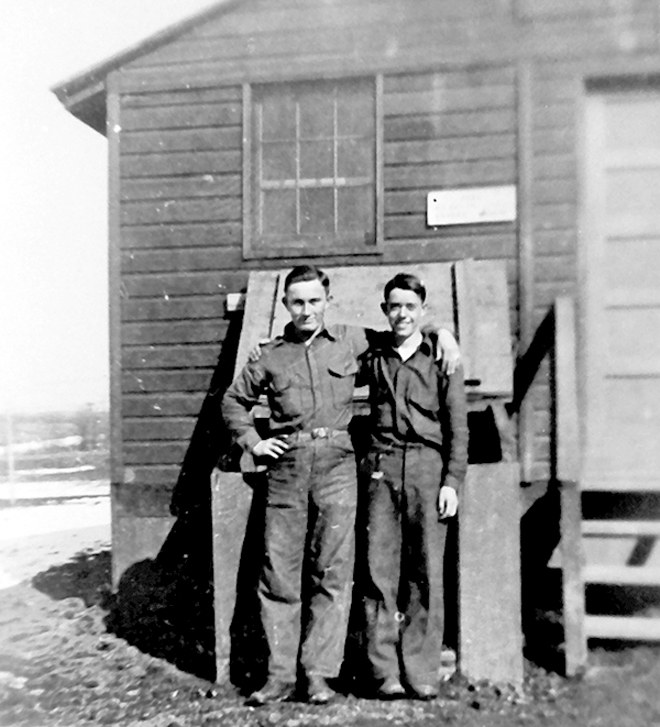
A couple of “CCC Boys” at the Gallatin Camp.
“As to past occupation, 35% were engaged in farm labor, 12% in clerical work, 10% in building trades, 5% still students, and about 16% either engaged in common labor or never having had gainful employment of a regular nature.
“The educational background of these young men is better than might be supposed, at least as far as years go, though some of the answers given indicate a weakness in our success with good old spelling and arithmetic. All boys had the equivalent of an 8th grade education, 33% were high school graduates, plus 8% who had one year in college and about 6% who had two or more years of education past the high school, counting in night school and correspondence work, both opportunities which many boys are not aware of.
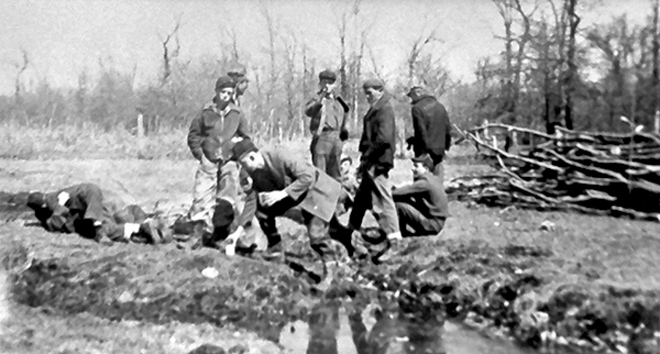
Drainage ditches and dirtwork were CCC projects.
“Among these older group two-thirds were church members and approximately two-thirds have taken part in two or more forms of organized sport.
“Asked to list benefits they have secured from a ‘stretch’ in the CCC, 75% mentioned learning more about constructive work, 35% spoke of improved health; 42% listed better co-operation and tolerance and fellowship while over one-fourth spoke of the importance of financial aid to parents.”
Camp leaders arrived and transferred frequently. Most appear to be lieutenants in rank. Camp leaders continually encouraged local businessmen and educators to supplement camp classroom curriculum. Most CCC Boys were involved in physical labor to complete specific projects. The organization, after all, was like military.

CCC camps included a rec center for enrollees between work schedules.
The comings and goings of CCC Boys were regularly reported in this newspaper, an effort penned by campers pursuing a journalism education. The regular column entitled “CCC Notes” frequently included sports coverage on baseball games played between the CCC Boys and teams throughout the area.
The six photos you see are selected from 16 shared by the late George Handley for archive. We welcome other comments and photos about Gallatin CCC camps and hope you’ll share.
Note: Last week’s focus on legendary basketball Coach Phog Allen of Jamesport prompted a comment from Mike Arnold, who notes that Phog’s father was one of the original incorporators (i.e. the Allen Addition) of Jamesport, MO, where Phog was born. Thanks, Mike. That’s the type of tidbits we’re looking for as we share more old film photos of Daviess County.