
By Darryl Wilkinson
This website brought to you in part by the following sponsor:

Find out how to advertise here - Email us! [email protected]
A couple of weeks back we focused on some old panorama photos, prompted by an unusual photo of a crowd assembled at the Gallatin CRI&P railroad depot in 1916. Old panorama photos are prompting comments.
 Elanor (McMahill) Best of Pattonsburg, for instance, has a panorama scene of the dedication of the “Tomb of the Unknown Soldier” taken at Evergreen Cemetery in Osborn, MO, following World War I. The unusual size of the original is measured in feet, not inches. This is another example of panoramic photographs, joining the Daviess County Courthouse and square (1915) and the train depot (1916).
How were these antique photos, sharply in focus and of superb quality, made?
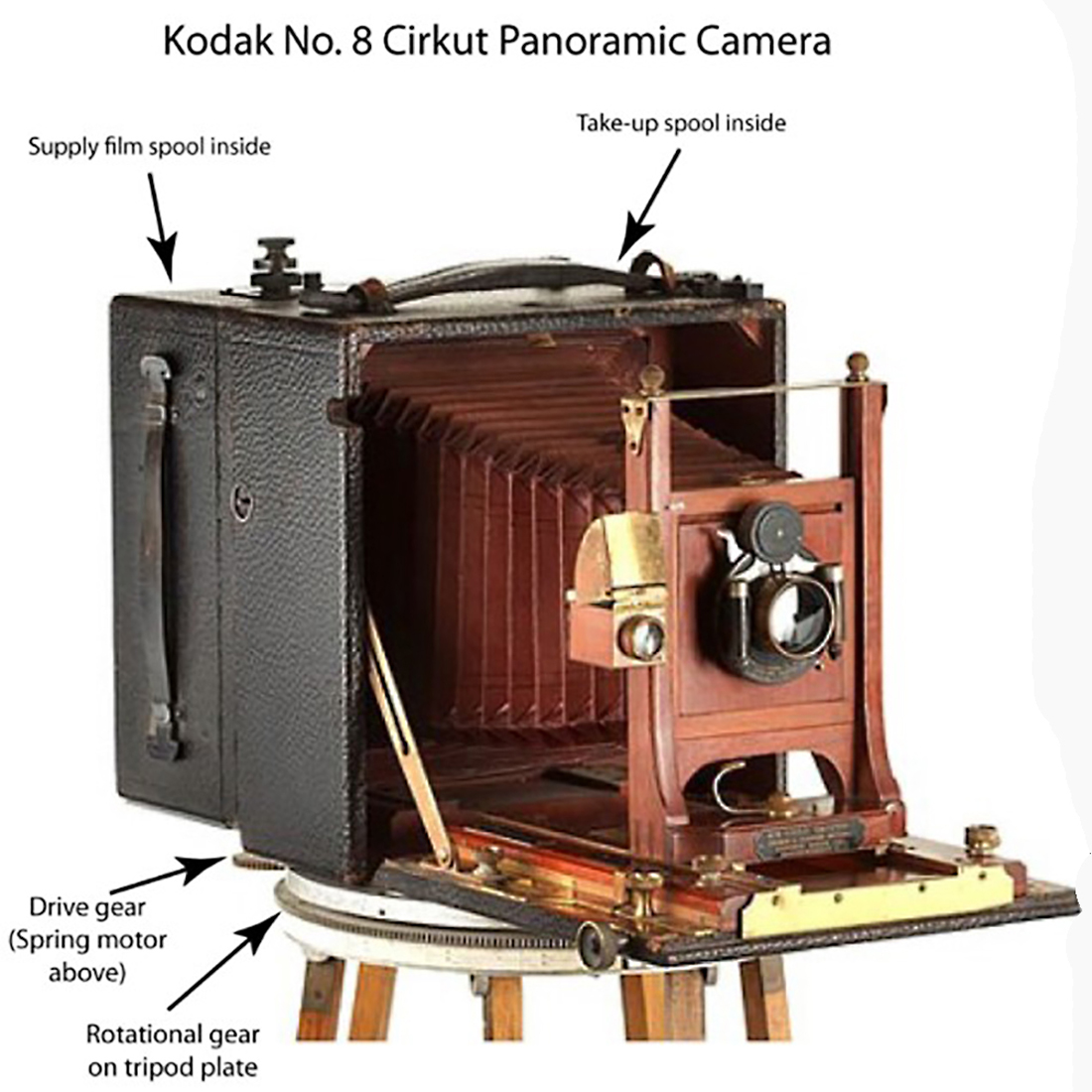
Paul Behling, who shared the depot photo, points to information provided by the Library of Congress. Panoramic photos are taken by the antique Cirkut camera which moves in an arc from left to right. The people are arranged along a corresponding arc, so that in the finished photograph they will seem to be standing in a straight line.
While under the hood, the photographer focuses the picture. Unlike a modern 35-millimeter camera, a Cirkut camera has no mirror and prism to reverse the image, and the photographer sees the picture upside-down. The aperture is “stopped down,” to allow only the proper amount of light into the camera. The back of the camera is loaded with film, and the gears are wound so that when the picture is taken, the roll of film and the camera move in perfect sync.
When taking a picture so that the photograph is not distorted, subjects featured in the photograph must hold very still to avoid blurred images in the picture. The photographer sets the angle of the arc that the camera will travel and releases the wound gear advancing the film and rotating the camera on the tripod. As the camera rotates it photographs one section at a time until it has exposed the entire length of film. Thus, the Cirkut camera does not take a snapshot. It takes a timed exposure.
 The Cirkut camera can also deliver other photos where image distortion is acceptable. The 1915 photograph of the Daviess County Courthouse, also showing most of the Gallatin business square, is an example. Obviously, all these buildings cannot be aligned on an arch to match the calibration of the camera’s rotation. But the skill in positioning the camera can still deliver a desirable photograph where images are distorted but interesting in effect. This Cirkut photo is more like a snapshot (few if any motion blurs are evident).
As my full retirement from work here nears, I’m spending time updating this newspaper’s photo archives. Folks like Paul and Elanor as well as Johnnie Black and others are greatly appreciated, not just for their interest in local history but for their willingness to share what they have and know with me …and thus with you.
Rather than portraits or pictures of people with no identification, I’m especially interested in scenes showing buildings, events, or landmarks that reveal anything Daviess County at a glance. As space permits, we print old photos in upcoming newspaper editions.
Going digital offers great advantages. Each image’s file is named so that titles are easily found by text search. What’s more, information about the scene is embedded in the file so that its description is never separated from the image. Work continues to organize these old photos into galleries – hopefully organizing “chaos” into meaningful presentations.
There are over 2,250 digital photos in our historical archive to date – but there’s only one way to find out if your old photograph is unique. Ask!
Currently I’m researching what I can find about the Civilian Conservation Corps (CCC). In 1934 a CCC camp was erected in Gallatin, south of the livestock auction barn. The late George Handley (remember when George ran a restaurant across the street from our old newspaper office on North Main?) shared 16 photos now in our digital archive. I’ve never seen others like these; I wonder if other local photos of Gallatin’s CCC camp exist.
If you have an unusual or photo, why not share? We simply take a digital photo of your original while you wait. That way your keepsake remains securely in your possession while allowing a copy to be presented for viewing by others.
Won’t you share? I suspect it’s less a matter of selfishness and more the challenge of remembering where that old photo treasure is stored. All I know is that I’ve intended to organize and update the photo archive here for years and more or less procrastinated until recently. Retirement has a way of putting things in perspective. So, as for me before my time here runs out, it’s time to share.