Gallatin man bears witness to events at Capitol, refutes idea that all were involved in violence
Jan 27, 2021 | Community News, Regional News |
Rolla Joyce of Gallatin was at the rally in Washington D.C. on Jan. 6. The gathering ended in calamity when a violent mob breached the Capitol, threatening the 535 members of a joint session of Congress who were gathered there to count the Electoral College vote. Five people died in the melee, including a Capitol police officer and a young female protester.
But the gathering didn’t start with dark intentions, Joyce says. It started as a gathering of like-minded people who only wanted to be seen and heard. “We weren’t nut jobs, just concerned citizens,” he says. For the most part, they were citizens worried about irregularities in the voting process, concerns they say have been dismissed by the press and government officials. Most were hoping for the opportunity for the electoral college to be audited.
“Seven or eight states sent dueling electors,” Joyce says. “We were thinking if it got kicked back to the state legislators, they could debate which ones were correct.”

2:34 People had climbed onto the Peace Monument Statue and the crowd was densely packed into the area west of the Capitol building.
Joyce was a reluctant witness.
“I didn’t want to go to the rally on Jan. 6,” he says. “I felt strongly impressed that I should go. I believe the only reason I was so strongly prompted to go was so I could stand as a witness. Not everybody there got wrapped up in the extremist activities, not even close.”
Joyce has not always been a Trump advocate.
“In 2016, I was part of the ‘Never Trump’ campaign,” he says. “But I thought he was the better option of the candidates. I was pleasantly surprised by what he ended up doing. I chalk some of my support up to the constant attacks by the Democratic party. They were holding anti-Trump rallies before he was even inaugurated.”
Joyce drove to Washington to join the rally. It took him about 18 hours. He got to the Shady Grove metro station around 5:30 a.m. on Jan. 6. He rode the red line train into Washington D.C. with a guy he’d just met from California named Jeff.
Moving toward the Ellipse along Pennsylvania Avenue, away from the Capitol building, Joyce saw trucks with dozer blades and police cars lined up along the side streets to keep vehicles out of the area from the Capitol Building to the White House, and Pennsylvania Avenue to “The Mall.” He and Jeff walked from Metro Central station to Pennsylvania Avenue then to Fifteenth street by the Ellipse, where a security check point was set up on Constitution Avenue. “There was a revelry type atmosphere, and upbeat music was playing on the loudspeaker,” he says. “The crowd was chanting U-S-A and whatnot.”

2:54 A giant USA flag is unfurled by protesters from the back of the bleachers that were already erected for the inauguration; onlookers cheered and shouted “USA,” and I heard some people start singing “God bless America”
Walking along with the crowd, Joyce was aware of agitation among some people caused by tweets from internet personalities, names he was not really familiar with. “Some conspiracy wonk was tweeting that Mike Pence and Congress planned to unseat Trump and seize power of the executive branch. That was the only outrage I actually heard voiced by the crowd.”
He arrived at the checkpoint at about 6:30 a.m. A giant line of thousands of people had started to form trailing south along the sidewalk to the Washington Monument, and around to Fifteenth Street and back to Constitution Avenue waiting to go through Security to enter the Ellipse. “The attitude was more or less one of merriment,” he says.
He noted an occasional Q-anon flag. He spotted internet personality Alex Jones as his ‘posse’ passed by. “Some people in the crowd were shouting, but it was not overwhelming, just the occasional person pumping a fist and shouting, ‘We’re with you!’ and ‘Yeah Alex!’ in approval,” Joyce says.
The rally was scheduled to start at 9 a.m. and President Trump was set to speak at 11 a.m. By 9 a.m., the area was full but not tightly packed. “It was wide enough that Jeff and I were able to navigate through. We could see and hear, but the sound system was awful.” They went back to the security check point in the middle of Constitution Avenue by the intersection next to the Ellipse. “We could see on the jumbotrons,” Joyce says. “At this point, the crowd just seemed happy to be there.”
At 11 a.m., it was time for President Trump to speak. But he didn’t arrive until 50 minutes later. He began talking at about 11:50 a.m. and ran for a little over an hour, ending at around 1:05 p.m. “It was hard to hear,” Joyce says, speaking of the sound system. “Trump began by clarifying the reason we were there. We were going to go peacefully down to the Capitol to let the pro-Trump legislators be bolstered by our support. Then he got into some information about various elections and how there were more votes for him than Biden and his postulations about that. You could hear half a sentence, and then the sound system cut out. It was hard to follow all of the information he was giving. At the conclusion, he said he was going to march with us, and that we would go to the Capitol together.”
And the crowd began moving toward the Capitol.
People tried to file out in order to clear the area in front of the Washington Monument, moving to Pennsylvania Avenue, Constitution Avenue, and Madison Drive. Joyce and Jeff walked along Constitution Avenue, and then to Pennsylvania by 10th street in front of the Department of Justice building, arriving at the George Gordon Meade Memorial about 40 minutes later. They spent another 15 minutes getting pictures of the amassed people across Madison, Constitution and Pennsylvania Avenues in front of the United States Capitol building.
“Everybody was in high spirits,” Joyce says. “One guy said, ‘Let’s storm the Capitol!’ and that got a laugh. Everybody thought it was hilarious. Unbeknownst to us, almost two miles away, people were trying to get through the perimeter of the Capitol at about exactly that time.” In fact, by 12:30 p.m. this other crowd of Trump supporters had gathered outside the Capitol, clashing with the police, and pushing forward to the building.

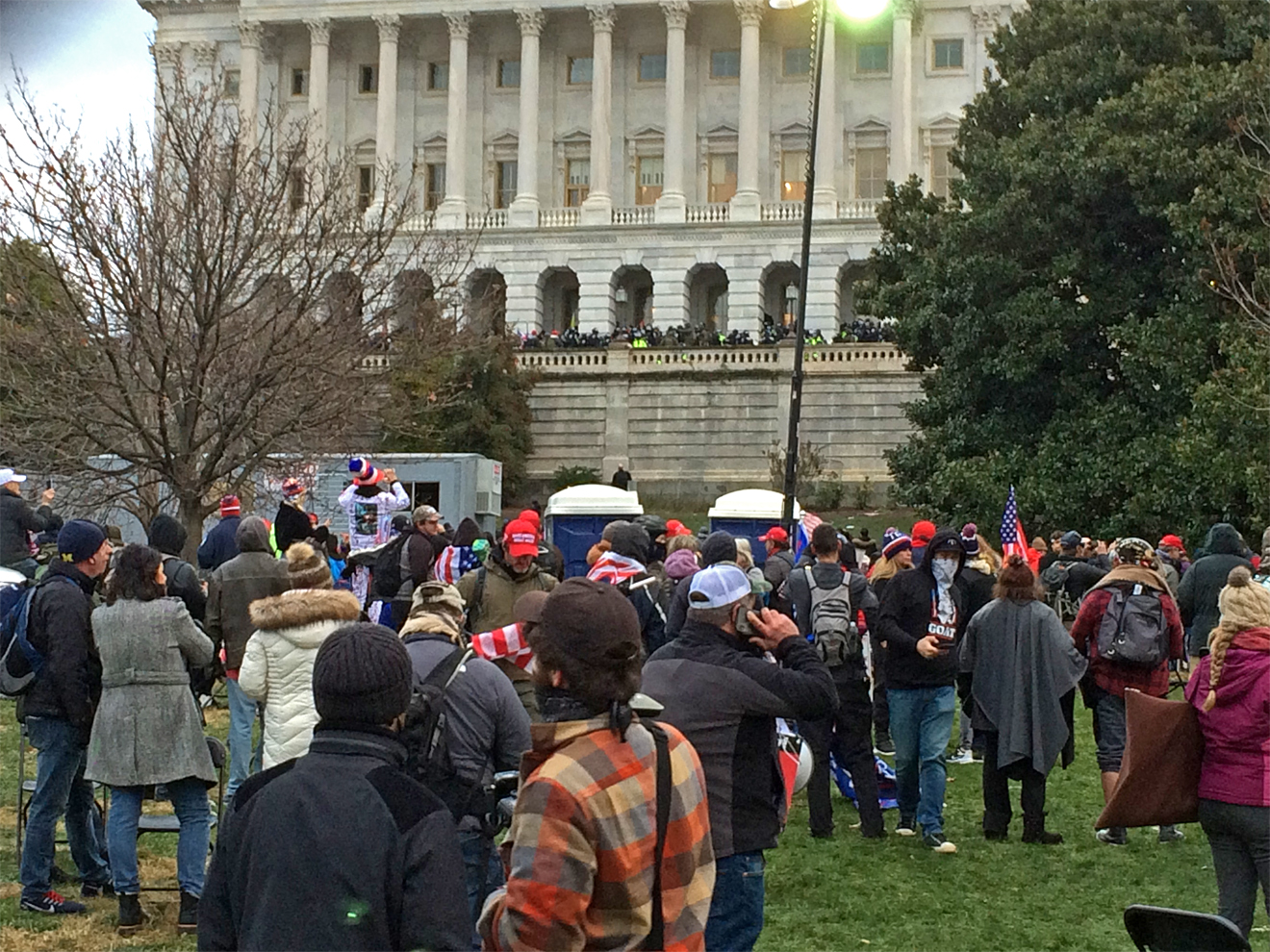
3:23 DC or Capitol Police block east entry to the Senate Chamber steps. The man below the right standing lamp with a white blow horn on his hip, partially obscured by a Trump flag, is the Q anon Viking guy with the horn hat.
Many in law enforcement believe that those really trying to “storm the Capitol” were not part of a protest or riot, but were part of a directed, coordinated attack on the Capitol by extremists, militia and hate groups. These groups operated under the belief that the great mass of people gathered would follow their lead and enter the Capitol behind them. Joyce says that idea that they were there as part of the rally, and motivated by the president’s speech is preposterous; and noted seeing some of them around the rally, but that they were staying away from the main crowds, and moving as a paramilitary looking group.
He, and the vast majority of the crowd, arrived at the Capitol well after the disturbance began. “It was curb to curb for five or six blocks,” he says. “We estimated half a million, maybe a million people.”
“Most people were being polite with the police,” he says. “The police were just doing their job.” In front of the Smithsonian African Arts building, three trucks of Homeland Security Officers were waiting to go across an intersection. “A group of guys were looking away from the trucks as they pulled into the intersection, and bumped into the fender of one of the trucks,” Joyce says. “The lead officer in the truck appeared, to me, to pull out in front of them on purpose. All three trucks stopped in a line.” Joyce yelled at the crowd from the sidewalk “Hey, stop! Make a hole, they are trying to cross!” The crowd stopped and the trucks drove across the intersection without further incident.
Still chanting “U-S-A” and “four more years” the crowd walked further east on Constitution. Joyce and his friend cut north on 10th to Pennsylvania Avenue. On 10th street in front of the Department of Justice, Joyce noted, “There were 12 to 14 police cars running but not occupied. There were eight or 10 in paramilitary outfits by the gates. They were wearing helmets and carrying assault weapons. There were another 16 or 20 uniformed police milling around.” Joyce stopped to take a picture of the quote over the door of the entrance. It was now 2:06 p.m.
Quickly Joyce and Jeff came out on Pennsylvania Avenue and joined the crowd headed toward the Capitol. They passed a lady shouting into a bullhorn as she read aloud the First Amendment of the Constitution which was inscribed on the front of the “Newseum Residences.” She read it over and over as the crowd passed by, adding particular emphasis on the phrase “Or the right of the people peaceably to assemble, and to petition the government for a redress of grievances.”
Things became more chaotic the closer they got to the Capitol building. Police cars with lights and sirens tried to drive through the crowd, but the crowd was so dense that they could not make room, and the cars had to stop. The crowd let them back up to turn around. All the police cars that Joyce saw on Pennsylvania Avenue were forced to go another direction. “At that point, people were climbing over and onto chairs and bleachers that had been set up for the inauguration by the Capitol Building,” Joyce says. “We could see spotters on the very top of the Capitol building. They were federal agents, no doubt, watching the crowd.”

3:23pm This was the EAST of the Capitol with media set up on the drained fountain over the underground visitor center and directly behind where the picture was taken near the Senate stairs.
Joyce believes, in hindsight, that it was strange that there were no loudspeaker announcements, no flash bangs, no attempts at crowd control that he could see; he assumed that the Capitol security was focused on the building itself, rather than on the grounds that were typically open to the public. “Later, we did occasionally hear flash bangs up above the north balcony,” he says. Joyce assumed that “people were probably going in through doors they weren’t supposed to.”
At this point, Joyce and his friend were separated. Jeff texted that he was on the east side of the Capitol, opposite of where they had entered, and Joyce started that way. He passed along the far side of the Capitol grounds in front of fenced area on the grass near Northeast Drive where the media had set up cameras. He would later learn that Alex Jones had purchased a permit to set up a stage and have a rally. People had come to the east side because Alex had tried to get the crowd to go to the stage on the east side of the building near the Senate Chambers steps, but reportedly the stage had not been set up or taken down, and Joyce couldn’t see any indication of a stage or Alex Jones.
“Even at this point, the crowd was more or less jovial, upbeat,” Joyce says. He and the crowd were still mostly unaware of the pockets of clashes with security and conflict at various locations in and around the building.

4:28 Capitol Police push the protesters that are occupying the upper landing; there was no audible indication that they were trying to ask them to leave, although this was after a minute or so of pushing, but the people were so deep and with nowhere to go they were slow to move; tear gas and flash-bangs could be seen and heard, although the tear gas ended up on the ground in the bushes more than on the landing.
Joyce arrived at the back of the Capitol building. There was a police presence on the steps leading up to the Chambers. It was 2:23 p.m. “It was still fairly calm. People were chanting, taking selfies, loudspeakers were saying various things. The guy with the horns was outside talking about conspiracies. I was too far away to hear what he was saying. Most everybody was just waiting for Trump to come.”
He received a call from his sister in Washington State who told him crazy pictures were being shown on the news of people charging around inside the Capitol building. “It was news to me,” Joyce says.
Some 10 or 15 minutes later, Joyce would bump into a guy who said somebody had been shot. “This guy said he was in the room when Babbit was killed,” Joyce says. “I asked him what was going on.” The young man said a group of people were “peacefully” trying to enter the Rotunda. He said they were unarmed, and that she had been shot for no reason, when they came to barricaded doors. Joyce recounted, “A girl tried to go through a window, and they shot her right in front of him.” “I said, ‘But you knew you were wrong, didn’t you?’ He said they were only being patriotic; they couldn’t be bossed around. I was like, you were the aggressor, you pushed through the barricade, you could have had a bomb, a gun, gas. He thought about it and agreed. He didn’t know what to do next. I told him to just go home. I shook his hand and gave him a hug and told him I was glad he wasn’t hurt, and he left.”
At this point, word began to spread through the crowd that something had gone down, and someone had been shot. As word slowly spread, most people including families and elderly started to leave, while some were curious to find out the circumstances. “There were rally goers there saying guards had let them enter the building. They shot video of the doors opening from the inside to let them in. They said the guards told them they could be there, but not to go anywhere else. Obviously, others went further.” Joyce reported.
Joyce and Jeff then went to the front of the Capitol building where not much had changed. People continued to wave flags and chant slogans. Two boom lifts had been left parked nearby for the inauguration. Apparently, the keys had been left in them and people were riding the booms up to take pictures and video. They didn’t drive them anywhere.

3:56 Tear gas can be seen near the entrance to the Senate Chamber side door that leads out onto the upper landing. This was also part of the problem with the earlier picture with the police essentially pushing the protesters through the tear gas that was there in order to try and clear it.
“About then, people started getting notifications on their phones of a curfew at 6 p.m. The curfew went out at 3:04 p.m. In hindsight, I had to wonder why it was not a more immediate curfew if something was wrong. Nobody really understood what all was wrong.” Joyce said that most people still assumed that it was a precaution to prevent violent clashes with BLM or Antifa after dark, and that made sense since it wasn’t an immediate curfew.
When word spread that a girl had been shot and killed, people started clearing out. “People said, ‘Oh, wow, that’s crazy’, and they started to pack up and go.” By 4:19, police had begun to use tear gas to clear the outer landings on the Capitol Building. Shortly after, Joyce made his way back to the train station, then to his car. He said goodbye to his friend who was flying back to California. Joyce drove home.
Joyce believes Trump could have more strongly condemned the violence, but that most involved were already committed to violence before Trump spoke at the rally. Most of the people at the rally were still at Trump’s speech at the first signs of trouble at the Capitol Building. “With anything Trump does, he’s always trying to save face. He’s concerned with his image. He could have come out more strongly, condemned the violence.”
“People were at the barricades before Trump’s speech even ended,” he says. “The Capitol was a mile and three-quarters away from where Trump gave his speech. And, personally, I didn’t hear anything in his speech that wasn’t typical political rhetoric. What I remember is him saying we would peacefully march to the White House and encourage those who were supporting our cause.”
Joyce, a school bus driver for the Gallatin School District, planned and attended the inauguration as an observer, an eye on the ground …. even though the mayor of D.C. asked people to not come to the city. “I think it is disgusting the way the Democrats and the media are vilifying everybody who voted for Trump as violent extremists. The truth is 99.99% of the people that were there are perfectly law abiding, upstanding citizens you can trust your kids with.”