
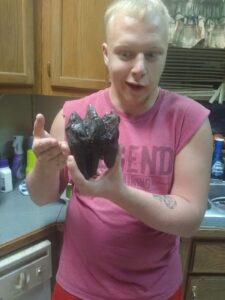
 Ira Johnson of Jameson was on a rock bar on the Grand River looking for antiques when he found the fossil of a Mastodon’s tooth.
Ira, 18, found the fossil on Aug. 29. A graduate of North Daviess High School, he now works at the school as a janitorial assistant. It’s a stressful job due to COVID-19. When he’s not working, he likes to go treasure hunting, mostly just walking around a couple of sites he knows, or using a metal detector.
He was searching around an old dump site on the side of the river. In the past he’s found silver-plated spoons, a Zippo lighter, a pocket watch, and a World War One button.
“I collect that kind of stuff,” Ira says. “I was walking along the bank near the water. I noticed this big rock about 10 feet away, and I thought that ain’t no rock. It was out of the ordinary. Not like any other rock, so I picked it up.”
Ira thought the strange, smooth, pointed rock looked like a tooth, but didn’t think a lot more about it. He hunted for another 30 minutes or so and went home and showed the rock to his parents, Stacey Rhoades and Scott Johnson.
His father likes to hunt for arrowhead and Indian artifacts and knew right away he’d found something.
“I showed it to my dad and his face brightened,” Ira says. “That’s when I knew it was no ordinary tooth.”
They looked online and found a picture of a fossil-tooth that was close. It was a Mastodon tooth.
His mother was tasked with getting hold of somebody who could verify the find. She reached out to two professors from the University of Iowa. Tiffany Adrain is the collections manager of the paleontology repository. Katherine McCarville is the professor of geo science. They verified that it was a mastodon’s tooth.
Mastodons were forest-dwelling herd animals. They lived on a mixed diet obtained by browsing and grazing. They are distant relatives of the modern elephants.
Ira says the fossil doesn’t weigh a pound; it’s about six inches long and a couple of inches wide.
Ira has gone back looking for more fossils, but has had no luck yet. His uncle found part of a mastodon tooth in the same general area four or five years ago, so he’ll keep walking those stream beds.
For now, he just plans to keep the fossil. He is displaying it in a case.
“I don’t plan to sell it; it has too much sentimental value,” he says.
It’s not every day you find a fossil from an animal that’s been extinct for about 11,000 years.
“I honestly thought it was just a cow tooth or a horse tooth,” Ira says. “I wasn’t thinking much about it. When I figured out what it was, I was astonished.”
This website brought to you in part by the following sponsor:

Find out how to advertise here - Email us! [email protected]