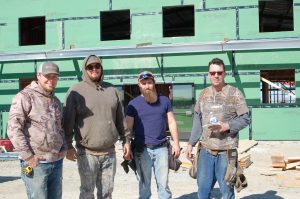
Pictured is the construction crew at the McBee Farm, Justin Hardy, Steven Ferrel, Mathew Limback and Gene Ferrel.
This website brought to you in part by the following sponsor:

Find out how to advertise here - Email us! [email protected]
Pictured is the construction crew at the McBee Farm, Justin Hardy, Steven Ferrel, Mathew Limback and Gene Ferrel.
This website brought to you in part by the following sponsor:

John Pettit is facility manager at the McBee Farm grain bin site. He is pictured with the computerized system that controls the grain bins and dryer.

Mike Hillyard fills in as manager when John Pettit is not there; otherwise, he’s a truck driver. Overhead computer screens provide information about the grain bins and the truckers.

Office portion of new building under construction.
Gene Ferrel, construction supervisor, says of his boss, Steven McBee, “When Steve does anything, he goes all out. His philosophy is ‘go big or go home’. I’ve done a lot of in-house construction for him through the years. He obviously knows what he’s doing.”
Ferrel and his crew are currently framing offices in the newest building at the construction site of McBee Farm and Cattle Company in the Industrial Park off Hwy. 6 northwest of Gallatin.
The building will house offices and a warehouse. The office space of the building is 60 by 40; then locker rooms with showers; and his and her bathrooms. The rest of the shop measures 240 by 100; it is open and includes a warehouse, a mechanic’s shop, and a wash bay. A lean-to measuring 25 x 240 will be used for outside storage. The two-story building will also contain meeting rooms and a kitchen.
Across from the new office building, bulldozers are currently clearing an upper pad for a helicopter hanger, according to Steve McBee. This will be 50 x 70 maintenance and storage area and will be managed by Steve’s brother, James McBee. James has been in the military for 33 years involved with Chinook helicopters. James has done three one-year tours in Iraq and Afghanistan and is a certified trainer for the military. James will be the chief mechanic. A pilot will be hired to fly the helicopter to spray fungicide and insecticide.
Another area is being cleared along the southeast side. This will be for an 80 x 100 truck wash and seed treatment facility. The north side of the building on that pad will be the truck wash measuring 30 x 100 and the south side will be a 50 x 100 seed treatment facility. The rest of the pad will be for equipment parking.
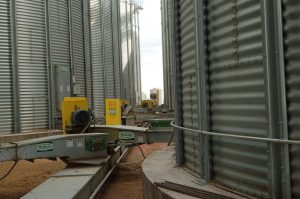
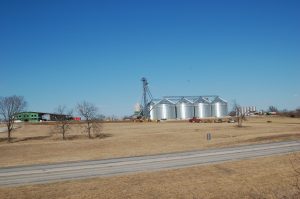
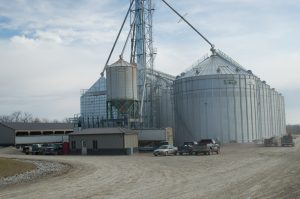
John Pettit is facility manager for the grain bins. The south row of four bins (1-4) are 60-foot bins. The north row of five bins (7-11) are 48-foot bins. Currently the steel grain bins hold 866,000 bushels. Bins 5 and 6; and bins 12; 13; and 14 will be built in the future. After they are built, the facility will hold 1.2 million bushels.
A machinery/equipment shed sits north of the grain bins. Between the building and the grain bins is currently room for trucks to park. As the facility expands, the trucks will move to the new equipment pad being built. On the far east side of the grain bins is a row of storage tanks holding nitrogen and fertilizer, fuel, an air/oil DEF truck center, and a dumpster pad.
“The drive on scale is computerized and lets us do everything in one shot,” Mr. Pettit says. “The truck drives on and dumps the grain; he doesn’t have to go back around to be weighed again.”
Inside the small-scale house everything concerning the bins is controlled with computers and high-tech devices. A tracking system follows the 12 McBee trucks so that Pettit knows where they are at any given time. He can tell when they are moving and when they are stopped. He knows the name of the driver and can even tell how fast they are going.
Computers control the bins. Once the trucker has dumped the grain into the pit, computers test the grain for moisture and foreign material; computers send the grain up the elevator and into the silos; computers run the dryer. The dryer is the biggest the Sukup company makes and there are only a few of its size in the nation. Mr. Pettit calls the conveyor system the “big leg” to the grain bins and “little leg” to the dryer. Not only can he follow the entire process on the computers and control it with a simple pop up keypad, he can see it in three dimensions.
He can print out grain hauler tickets and has a radio system to talk to company trucks as far as north of Princeton. A closet-like room contains all the electrical system, breakers, and transformers. A surveillance system monitors the facility and grounds even when no one is on site. It notifies of any activity with text alerts.
“It’s a pretty neat system,” Pettit says. “It’s all computerized, all automatic controls. I don’t have to do anything outside except open the bin doors.”