

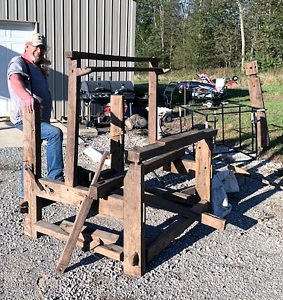


 “Where did it come from? How did it end up in the Kulis Building? Who did it belong to?”
These are questions that intrigue Jan Stout, about a barn loom recently discovered in a lean-to behind the Kulis building, located next to Courter Theater.
In the meantime, Mark Gay has the loom set up in a shed on their farm north of Gallatin. He isn’t sure how the contraption works. He says he’ll figure it out. He’s learning a lot of terms he never thought he’d use in his lifetime … like heddle and treadle and warp and weft.
Mark can identify most of the parts of the loom; there are back beams and cross beams and beaters and rollers. Standing upright next to the frame is a large pole-like structure with pegs that has not yet been attached to the main frame.
“I thought it might be a torture rack,” Mark says.
He’s joking, of course, but he’s thoroughly intrigued. This is the warp roller. It is eight-sided and probably made of walnut. He’s figured out that it goes vertically instead of horizontally as he first thought.
“All the pieces are hand-made and I’m amazed that the warp beam was carved so nicely,” Mark says. “It’s not as heavy as it looks. It weighs about 80 pounds. It’s a spool for the thread. You wound as much thread as you could get on it. Sometimes 24 spools at once. ”
This website brought to you in part by the following sponsor:

Find out how to advertise here - Email us! [email protected]
A lost treasure in the Kulis Building
Weaving is pretty much a lost art, and this loom was almost a lost antique. The Kulis building was acquired by the Gallatin Theater League about four years ago. The owners of the Kulis building had no use for it and no resources to fix it up. It sits right next door to the old Courter Theater building. So they asked the theater league if they’d like to have it. The theater board said yes and it was signed over.
“The Kulis building was a disaster,” says Jan. Both she and Mark are members of the theater league. “It was full of stuff, including an upstairs apartment. We went in and ripped it all out. There was a building not attached, a sort of lean-to. We went to see what was in that. Mark saw these pieces of wood. He and his brother Keith talked about what it could be. They had no idea.”
Mark laid the pieces aside. That brings us to late fall 2019 when the theater league had the Boy Scouts clean up the alley behind the Kulis building. The scouts threw the old wood in a scrap pile.
“I came out of play practice and saw it laying there in the grass,” Mark says. He asked if he could have it and gathered it up and took it to his work shop.
Research reveals a unique rocker-beater loom
“I started researching online to figure out what it was,” says Jan. “I thought it might be something industrial. Mark started putting it together. With no model to go by, he just guessed where the pieces would fit. And suddenly we realized … it’s a loom!”
She came across an internet site, Rocker Beater Loom Site – Ohio University.
Jan realized the loom pictured on the site was exactly what they had, and that it was quite rare.
“Barn looms are so called because they were made by carpenters who also knew how to build barns,” Jan says. “The same mortise and joinery is used in both. The pieces are hand hewn and pegged together without nails.”
According to information Jan has gathered, in the decades following the American Revolution, a radical new loom style began appearing on the western frontier.
Generally speaking, what set this loom apart was its beater (the apparatus that beats the thread into cloth). Rather than hanging from the loom frame in the typical overhead position, this beater operated from a standing position, and it was supported by a set of wooden rockers (not unlike those on an infant cradle or a rocking chair) that rested on the base of the loom and facilitated the beating action.
There are only 65 or 66 such known Rocker Beater Looms left in the United States in museums or private collections. There are nine in Missouri.
“I suspect there are a lot more, but people don’t know what they have,” Jan says.
Specifically speaking, less is known about the history of this particular loom. The looms were made on demand and were one-of-a-kind.
“Often a family member made the loom, based on a design from the Old Country,” says Jan. “A father made one for his daughter’s wedding gift or a husband made one for his wife.”
According to Jan’s research, the earliest looms were dated 1797. They originated in the Appalachians.
“There were quite a few in southern Missouri and in Northern Arkansas, a lot in Indiana,” she says. “According to the Daviess County History Book, Nancy Peniston wove the first cloth in Union Township. Peniston is a familiar name in the area.”
Figuring out how it works
Weaving is the process of making cloth by crossing two sets of threads over and under each other. Almost all looms have the same basic features and weave fabric in much the same way.
It may look like a simple machine. It isn’t. There are three methods of weaving on a rocker beater loom. This one uses the counterbalance method.
“It took me the longest time to read and research how it worked, to understand the concept, evens and odds, ups and downs, top and bottom,” says Jan.
First comes the thread. A set of “warp” threads is wound onto the cylinder called the warp beam at the back of the loom. The warp thread stretches lengthwise on the frame. The warp threads are under tension between the warp beam and cloth beam on the loom.
There are two sets of harnesses. These are the pieces of wood at the top and bottom. Located on the two harness frames are little eyelets called heddles. Each warp thread goes through one heddle eye. This prevents the threads from tangling. The even-threads go through one set of harness; the odd-threads go through the other set. The odds go up, the evens go down. This is what makes the shed.
The “weft” is what the crosswise threads are called and they must be repeatedly drawn over the warp.
The weaver winds the weft thread around a spool called the “bobbin.” The bobbin is held in an oblong container called the shuttle. The shuttle acts as a needle that draws the weft thread over and under the warp.
The weaving process starts when the weaver lifts the harness that holds the odd numbered threads. This action creates a space called the “shed” through which the shuttle and weft thread then pass.
Finally, the weaver lowers the first harness and pushes the newly woven row into place with a device called the “beater” or “reed.” The reed is in a frame, located in front of, and parallel to, the harness. It has comb-like teeth made of steel wires that push each weft row compactly into place to tighten the weave.
To weave an additional row, the weaver raises the second harness and passes the shuttle through the shed. The weaving of each row involves the same process.
The finished cloth is wound around a bar called the “apron beam,” or “cloth beam,” at the front of the loom.
“The key to make it work was the harness, which is operated by treadles which sit on the floor,” says Jan.
A brake stop is needed so the string remains taut. There are two brake stops.
Jan and Mark don’t have the reed. But you can buy the reed. They don’t have the harnesses and they have only one treadle for the bottom.
“But it’s a three treadle machine,” says Jan. “I’m not sure how that works.”
Mark is missing three pieces, which means he has three pieces to make.
“It was quite a process to thread it,” Mark says. “It’s pretty clever.”
The loom finds a home
Every loom is different. First of next year, Mark and Jan are planning to visit a working rocker beater loom in South Missouri.
“We need to take a look at the counterbalance and learn how to use the brakes,” Jan says.
Once restored, Jan plans to house the antique loom in the front room of her home. And she plans to use it.
“Yes, I think I can weave on it,” she says. “Nothing fancy, maybe a rag rug.”
Thus, this handmade rocker-beater barn loom will go from the scrap heap to become a treasured family heirloom once again.
“If anybody knows anything about this loom we’d love to hear from them,” Jan says. “Hopefully someone in the area will remember a grandma who used to weave. It’s fun and fascinating to think about. Where did it come from? How did it end up in a lean-to in the back of the Kulis building? Why did someone give up such a wonderful family heirloom?”
From the Daviess County History Book:
Looms and weaving were definitely an important part of early local history. The History of Daviess County Missouri, Birdsall and Dean, 1882, records the weaver of the first cloth on the first loom as certainly as who built the first church and first school, or who was the first birth, marriage or death in the township.
Like all early settlements, it was the pioneer women who looked after the clothing of the family, and the spinning wheel and old hand loom had a place in the corner of the log cabins in those days. Buckskin, corduroy for the men, homespun, calico and gingham for the women…
In Jamesport Township Mrs. Rachel Miller and Mrs. Eleanor Gillilan did the first weaving, not only of the homespun for dresses, etc, but of carpets. It was the rag carpet of those days that did the duty in the parlor.
The first loom ever built in Benton township was the work of H.W. Enyart. His wife Mary Ann did the first weaving, and this was in the year 1834. This lady also did the first carding and spinning in the township. Like all the pioneer women of the early times, she not only made her own clothes but those of her husband and children. In 1835, Mr. Enyart’s cabin and all its contents, except the loom, were burned. They saved nothing but the clothes they had and the loom. The first rag carpet ever woven in Benton Township was by the hands of Mrs. Hulda Powell.
It was as early as 1833 that Mrs. John Martin and Mrs. John Tarwater did weaving and spinning in Grand River Township, and it is not much a matter of doubt that these pioneer women of Daviess County were the first to hear the whirr of the spinning wheel and the click of the shuttle in the county. Mrs. Mary Grant, wife of John Grant, made a regular business of weaving in another section of Grand River Township. Her loom was in motion in 1840, but the writer cannot say how much earlier.
Mrs. Anthony McMullins, Mrs. Anna Kelso, and Mrs. Nancy McCreary were the first to weave and spin in Sheridan Township. They did the first work of this kind in the township in 1835, and the shirts for the men and the dresses for themselves were all made out of the same line of goods. It was warm, comfortable, and durable and that was the great object in those days.
Mrs. Nancy Peniston wove the first cloth in Union Township.
In the industrial arts, Mrs. Hannah Everly wove the first cloth in Lincoln Township.
Mrs. John Williams not only had the first deerskin carpet, but wove the first cloth in 1837 in Washington Township.
In nearly every family there was a weaver of more or less proficiency, who wove the cloth used by the family, but Mrs. Rebecca Clevinger and Mrs. William Roper were especially noted as accomplished weavers in the early days of Marion Township. They wove nearly all the cloth requiring considerable skill and knowledge of the loom and shuttle.
Mrs. John Oxford did the early spinning and weaving, and was the owner of the first loom in Jackson Township.
The inevitable spinning wheel and rough loom, which were two of the necessities of pioneer life in Liberty Township, found a lodging place at the home of Mr. Prewett and his wife Nancy as early as 1835. They were using these very essential articles of domestic furniture. She was able to keep her family in the necessary wearing apparel in the shape of homespun.
The first spinning and weaving was done by Mrs. Charity Weldon in Harrison Township.
The first weaving in Monroe Township was done by Mrs. Prater and Mrs. Ward and they made some very fine homespun for dresses.