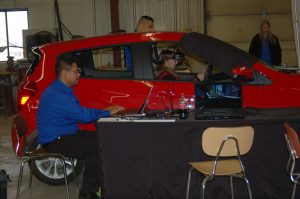
Gallatin High School student Cidnee Toney is behind the wheel while a simulator presents a drive through a virtual city. AR is an emerging technology that enhances reality by overlaying the virtual world over the real world, allowing students to see both at the same time.
The Peers Foundation presented an Augmented Reality Distracted Driving Education Simulator (ARDDES) to Gallatin High School students on Oct. 29 in the ag shop. The program was initiated through Family, Career and Community Leaders of America. FCCLA completed the Buckle Up Phone Down program through Missouri Department of Transportation in the 2017-2018 school years.
Missouri teen drivers rank among the worst in the nation, coming in at 48th, according to a recent study of the Best & Worst States for Teen Drivers by WalletHub. In an effort to begin changing that statistic, the PEERS Foundation, a Grand Rapids, MI, based non-profit organization, has taken its ARDDES Aware Distracted Driving Prevention Program to 10 Missouri high schools this year thanks to funding from the Missouri Department of Transportation.
“Missouri is the first state department of transportation to partner with us,” said PEERS Foundation’s Chairman of the Board Mike Seymore when the state’s federally funded National Highway Traffic Safety Administration (NHTSA) grant was announced. “The award will fund our program at ten schools that reported having less than 60% seatbelt use among teen drivers in 2018.”
The 10 schools receiving ARDDES are Gallatin, Kennett, Malden, Caruthersville, New Madrid Central, Westran, Lafayette, Liberty Mountain View, Milan, and Sikeston.
Safe Driver Educators Josh Jackson, Julie Piotrowski and Timmus Pong told the GHS assembled students that distracted driving is the number one cause of fatalities in ages 16 to 29. Eleven young drivers die every day due to distracted driving. Smart devices and activities like texting while driving have caused driver fatalities to rise at unprecedented levels.
The ARDDES (short for Augmented Reality Distracted Driving Education Simulator) Aware experience incorporates live teaching, video testimony, and peer interaction with the PEERS Foundation’s state-of-the-art driving simulator. Wearing a Meta2 augmented-reality headset, the ARDDES simulator challenges participants to make quick decisions regarding realistic distractions from oncoming traffic, pedestrians, passengers and cell phones while ‘driving’ to avoid potential (simulated) collisions.
“We’ve made it as realistic as we possibly could,” said Seymore. “We use a real car for the simulator, and in addition to seeing the actual dashboard and their own hands on the steering wheel, participants see oncoming and passing traffic in the car’s rear-view mirror and windows. A person could actually stick their head out of the car’s side window and still be completely immersed in the virtual world that we’ve created.”
With 88% of participants from the 2018-19 school year either agreeing or strongly agreeing with the statement, “After experiencing the simulator, I am more likely to eliminate distractions while driving,” post-event surveys indicate that the ARDDES Aware program is successfully raising awareness and changing behaviors related to seat belt use and distracted driving.