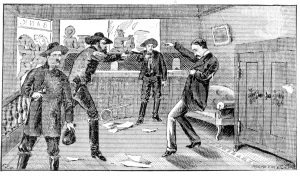
On Dec. 7, 1869, between twelve and one o’clock, two men entered the office of the Daviess County Savings Association. One of them asked the cashier, Captain John W. Sheets, to change a hundred dollar bill. Cashier Sheets went into the back room to get the money, when he was shot. Hearing the shot, Mr. McDowell, the only other person in the bank, turned quickly and was immediately covered. He managed however to get out of the door and gave the alarm, although pursued by one of the bandits who shot at him several times. Hastily gathering up what funds they could get quickly, they mounted their horses and rode away, closely pursued by citizens who had heard the alarm. They managed to escape. One of the horses escaped and it was afterwards proved that it had at one time been the property of Jesse James. In a letter to Governor McClurg, dated June, 1870, Jesse James stoutly denied that he had anything to do with the robbery and murder, and said that while the horse captured had belonged to him, he had sold it prior to this time. A number of people testified that they had seen him at other places during the time of the robbery .
On the night of July 15, 1881, the Rock Island train was robbed by seven men, who boarded the train at Winston, and began work as soon as they were out of town. When the order of “Everybody down” was not obeyed by Conductor Westfall, he was promptly shot down. Other shots were fired, Frank McMillan also being killed. Two of the men took charge of the engine, while others entered the baggage car and forced the messenger to open the safe. The amount secured was estimated from $3,000 to $15,000. Again the James gang was suspected of the robbery and murder, but again nothing could be proved.
In 1882, Frank James gave himself up upon the promise of the Governor that he would be given a fair trial. He was brought to Gallatin in December, and was confined in the stone jail which was on the northwest corner of the public square. The trial was begun Aug. 20, 1883, Judge Goodman, of Albany, presiding. Dr. A. F. McFarland was Circuit Clerk, and his deputy was William Sheets. George T. Crozier was sheriff and his deputy was Gabe W. Cox. Major S. P. Cox, A. P. Shour, John Bowen and William Hamilton were also deputies and jury attendants.
The attorneys for the State were William H. Wallace, of Kansas City, John H. Shanklin, of Trenton, William D. Hamilton, Prosecuting Attorney of Daviess County, and J. F. Hicklin, Gallatin, Frank James had as his attorneys, Charles P. Johnson, John M. Glover, of St. Louis, John M. Slover, of Independence, Mo., J. W. Alexander and Wm. Rush, Jr., of Gallatin, and Judge John F. Phillips, of Kansas City.
The jurors were J. B. Smith, age 26; Charles R. Nance, 45 ; Jason Winburn, 39; Richard E. Hale, 24; James Snider, 37; Benjamin Feurt, 37; Lorenzo Gilbreath, 46 ; W. F. Richardson, 53 ; William Merritt, 33 ; Oscar Chamberlain, 31 ; A. B. Shellman, 37 ; James Boggs, 57.
The selection of this jury required four days. Over 200 witnesses were subpoenaed. Among them were Mrs. Sarah Hite, Dick Liddell, General Joe Shelby, Mrs. Zerelda Samuels, John D. Samuels and Mrs. Allen Palmer.
The crowds which a trial of this sort would attract can be imagined. All the leading newspapers in the country sent special representatives.
The jury stood 11 to 1 in favor of acquittal on the first ballot. Lorenzo Gilbreath being the only one favoring conviction. He soon gave in and James was acquitted.
[History of Daviess and Gentry Counties Missouri – (Daviess County portion by John C. Leonard and Buel Leonard – Printed by Historical Publishing Company, 1922 – Transcribed by Veneta McKinney]
A couple of Gallatin attorneys involved the Frank James trial went on to be well-known in their day.
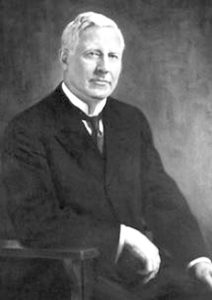
J.W. Alexander :(January 22, 1852 – February 27, 1936) In 1882 he was elected to the U.S. House of Representatives. He was in his freshman term when his hometown Gallatin was in the national spotlight as the 1883 trial of Frank James took place. He was quickly recognized for his abilities and became chairman of the House Appropriations Committee in just two years. In 1886 Alexander became Speaker of the House. From January, 1901 through February, 1907, J.W. Alexander served as Judge of the Seventh Judicial Circuit. He resigned this post to return to national politics, taking his seat in the 60th Congress. When the Democrats gained majority control of Congress in 1910, Judge Alexander was named chairman of the Merchant Marine and Fisheries Committee. It was in June, 1872, that 20-year-old Joshua Willis Alexander came to Gallatin to visit classmates. He sought the company of the sons of Samuel A. Richardson, whom he met while attending Christian University at Canton, MO, near the Mississippi River. Mr. Richardson induced him to remain in Gallatin to study law in Richardson’s office. J.W. Alexander was in public life for nearly 50 of the 64 years he called Gallatin home.
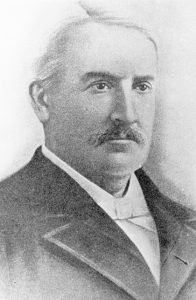
Billy Hamilton: Mr. Hamilton established himself in Gallatin and opened office in February 1875. In 1878 he was appointed city attorney of Gallatin and served four terms in that office. In 1882 he was elected prosecuting attorney. While acting as an officer of the State, he was one of the prosecutors of the notorious bandit, Frank James. Some of the most gifted lawyers of the West were engaged as counsel in that case, among whom was Judge John F. Philips and ex-Governor Charles P. Johnson, and in all respects the young prosecuting attorney showed himself of a mental stature great enough to compete with the legal giants who opposed him. During his second term he figured in another cause celebre, acting as the prosecutor of Jo Jump and John Smith, for the murder of W.E. Gladson. They were convicted and duly hanged in 1885, this being the first and only execution that has ever occurred in Daviess County. These cases gave the public an idea of the young attorney’s exceptional ability as a criminal lawyer, and since then he has appeared as counsel in almost every criminal case of importance tried in that section. He has defended a number of clients accused of capital crimes, and has never yet had a client convicted. [History of the Bench and Bar of Missouri]
Tom Crittenden: Thomas Theodore Crittenden (January 1, 1832 – May 29, 1909) was a United States colonel during the American Civil War, and a Democratic politician who served as the 24th Governor of Missouri from 1881 to 1885. Mr. Crittenden never called Daviess County home, but he was connected by the James Gang.
Crittenden was elected Governor of Missouri in the 1880 election.[3] As governor, Crittenden wanted to suppress the robberies and violence committed by the James Gang.
He authorized a reward of $5,000 (which was paid for by railroad corporations) for the capture of Jesse James and also for his brother Frank, dead or alive, which resulted in Robert Ford killing Jesse in 1882. Following Ford’s conviction for the murder, Crittenden pardoned him. On October 5, 1882, Frank James surrendered in Jefferson City.[4]