
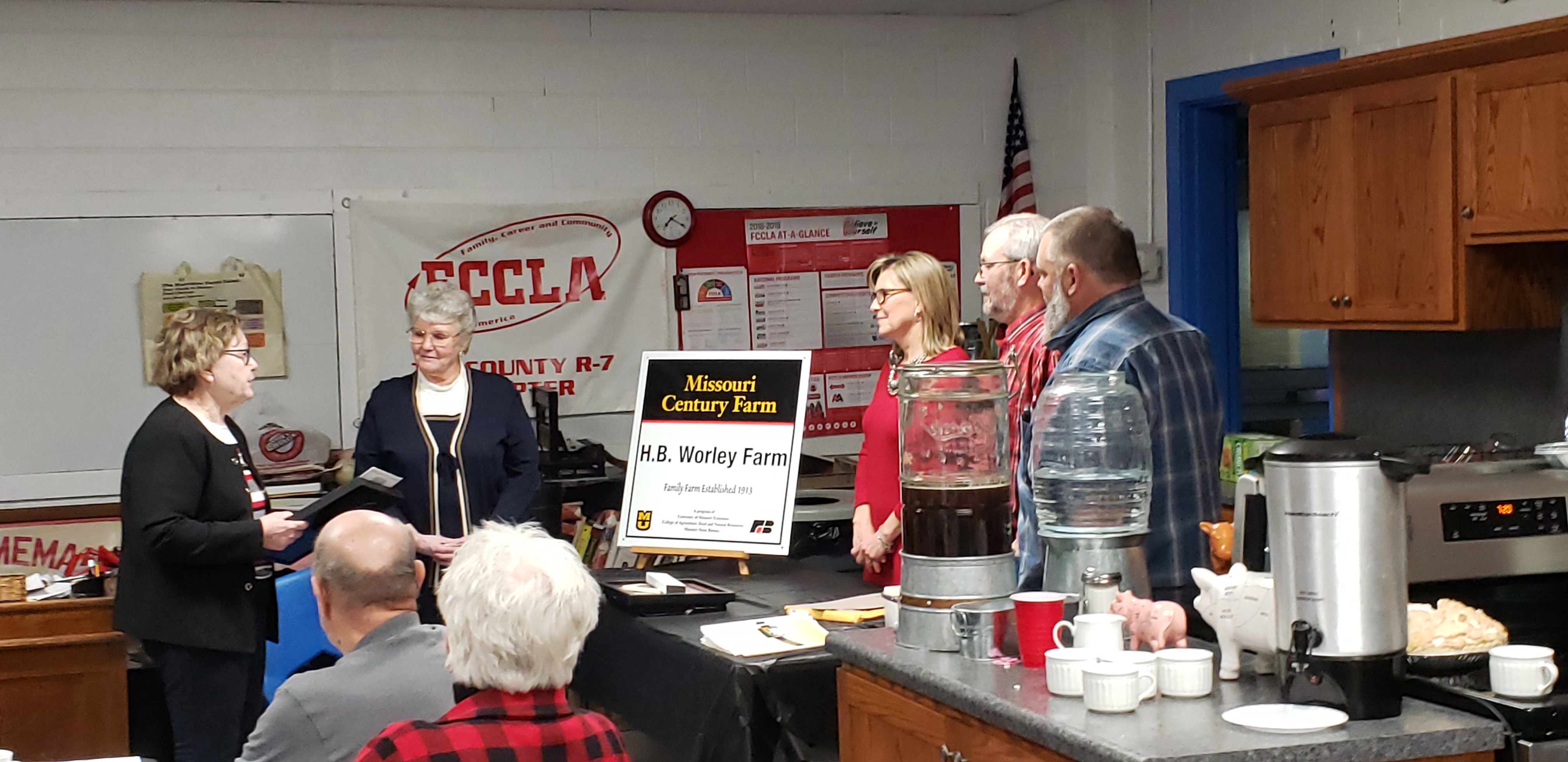
Jayla Smith, Verna Rose Cole Swisegood, Lana Crawford, Darrin Cole, and Clint Cole
This website brought to you in part by the following sponsor:

Find out how to advertise here - Email us! [email protected]
The family of H.B. Worley was honored at the 2019 University of Missouri Extension-Daviess County annual dinner. The Worley family is one of 83 farms in Daviess County to earn the recognition. The farm was acquired in 1913 and consists of 77 acres of ground to remain in the family since that date. In attendance to accept the sign, certificate and booklet were Verna Rose Cole Swisegood and her children, Lana Crawford, Darrin Cole and Clint Cole.
If your farm has been in your family since Dec. 31, 1919, you can apply to have it recognized as a Missouri Century Farm.
To qualify, the same family must have owned the farm for 100 consecutive years. The line of ownership from the original seller or buyer may be through children, grandchildren, siblings, and nieces or nephews, including through marriage or adoption. The farm must be at least 40 acres of the original land acquisition and make a financial contribution to the overall farm income.
Applications will be accepted at the University of Missouri Extension-Daviess County office Feb. 1-May 15. For more information, call 660-663-3232.
Historical overview of the Century Farm program
In 1976 when Missouri had the American Revolution Bicentennial, Governor Christopher Bond indicated that agriculture should play a prominent role in Missouri’s Bicentennial celebration since agriculture was the state’s number one industry….
Century farms and ranches have shaped the nation. Amidst every kitchen, behind every faded barn door, and in every soiled and calloused hand lie untold stories of those who feed our nation. As an industry, we are called to discover these stories and share with consumers everywhere the contribution farmers and ranchers have made to our American heritage. It is time to redefine sustainability and put a face to the farmer who fills our cupboards and clothes our backs.
Therefore, the Missouri Committee for Agriculture felt that the best way to plan involvement and carry out successful Bicentennial activities was at the local level. Plans were made to form county agricultural emphasis bicentennial committees.
In January 1975, area extension specialists designated as the “agriculturalists” were mailed the procedures for organizing county agricultural emphasis committees. The procedure called for the “agriculturalist” to meet with a nominating committee consisting of members of county farm organizations and appoint a county agricultural emphasis committee. The purpose of the county committees was to give leadership in seeing that agriculture had its appropriate place in American Revolution Bicentennial historical, festival and horizon activities. Agriculture should be an important part of overall ARB activities.
On June 1, 1975, the Missouri Committee for Agriculture-ARB hired Jerri Sloan, an agriculture journalism graduate, to assume full-time responsibilities as the committee secretary. Her office was housed with the agriculture editors on the University of Missouri-Columbia campus. Agricultural editor at the time, Dick Lee, devoted much time and support to the committee’s efforts.
The Centennial Farm project awards certificates to persons owning farms that had been in the same family for 100 years or more. A total of 2,850 Missouri farm owners in 105 of Missouri’s 114 counties were recognized as Centennial Farm owners.
Interest in the program continued after 1976. Several Missouri farm owners asked about having their farms recognized, so the University of Missouri College of Agriculture, Food and Natural Resources and University of Missouri Extension planned a 10-year update in 1986 called the “Century Farm” program. During this update, 1,080 farms were recognized.
Long-term family farm owners who were not able to take part in the 1976 or 1986 events still wanted recognition, so the College and MU Extension planned for annual updates. Since 1987, an additional 5,504 farms have been recognized. The program has continued with 100 or more farms being recognized each year.