
Joe Caraway, 85, says all of his life he has heard the story about how his grandfather George Caraway was shot by burglars and nearly died.
This website brought to you in part by the following sponsor:

Find out how to advertise here - Email us! [email protected]
“I’ve heard all about it and read all about it,” he says. “But I’m not sure my grandchildren have.”
In order to make sure this historical event gets passed from one generation to the next, Joe has been making full-size copies of the newspaper article to give to his grandchildren so they can read about it for themselves.
The story appeared in the Gallatin Democrat on April 1, 1909, under the title “Desperados Shoot an Official.”
“I remember my grandfather George from when I was a little boy and he was quite elderly,” Mr. Caraway says. “He served one term as city marshal. I don’t know of anyone else in the family that served as lawmen. Most have been farmers.”
Lest the story of the “Nitro Chism Gang” robbery fade completely from the collective memory, here’s a recap of what happened …
The Trenton newspaper reported that the town of Spickard was sound asleep that Sunday morning when three robbers blew open the safe in the Farmers’ store with nitroglycerin. A half hour later they blew a safe in the J.L. Moore jewelry store, located in the lobby of the post office building. Their total loot was about $500.
Some minutes later they took a handcar from the shed at the Rock Island station and started toward Trenton. A mile north of this city they were met by officers, but the burglars saw the policemen first and dodged them in the darkness, running their handcar into the ditch.
According to the Gallatin Democrat, on Monday morning, March 29, about 11:30 a.m., the local westbound Rock Island freight pulled into Jamesport. The conductor was advised by his brakeman that three men had climbed on the train as it came up the hill, east of Jamesport, and were in a box car.
The train crew had already been notified that several burglaries were committed at Spickard the previous night and to be on the look out.
The brakeman went up town to get the city marshal, George Caraway, and found him at Kingdon’s Hardware Store. By the time they arrived back at the station, the men had gotten off the train. The brakeman pointed out a man with a grip standing on the platform as one of them.
The brakeman and the marshal went to arrest him. They each took hold of him and started toward town.
They had not gone far when the two other men came around some box cars. The two had been uptown at Arnold’s store buying provisions.
One of the two drew his gun and fired at Marshal Caraway, shooting him in the back. The bullet struck him about two inches to the right of the spine. It went straight through his body.
“The bullet lodged in some papers in his upper vest pocket. All those papers fell out when they got him home and took off his coat,” says Mr. Caraway. “Then he was shot at again but they missed. That bullet went through his coat under his arm. My grandfather was unarmed.”
Joe says his grandfather usually carried a weapon, but just didn’t have a gun on him that day.
The three desperados made a dash for liberty. They crawled under the train and went south through the Jamesport park, where they hid their grip and some plunder and made off across country.
“My grandfather started back to town and gave out,” says Joe. “They didn’t think he would make it; they thought he was mortally wounded.”
George and his wife Rowena had four sons, Levi, Sydney, Kenneth and Frank.
It was several minutes before an organized posse, with the former sheriff Hutchison at its head, went in pursuit of the men.
Guns of every description were brought into requisition from stores and homes and ammunition was in abundance from the three hardware stores in the town.
“They had phone lines back then and the phones were buzzing,” says Joe. “They were calling all the farmers on the telephone line south of Jamesport and warning them to be on the lookout. They were guarding the crossroads and the railways.”
The posse had no trouble getting on the trail of the fugitives, but they found it a hot one.
“Every time they got close to them, they’d hunker down on the ground with their Colt automatics and shoot back,” says Joe. “Bullets were whizzing around the posse.”
It was during one of these exchanges that Ed Harris, a blacksmith who had come out from Lock Springs with a posse to assist in the capture, got a bullet hole in his coat.
Daviess County Sheriff Atch Blair was over in Jackson Township, south of Jamesport, serving papers for the coming term of court, when he learned of the crime and the chase, and immediately set out for the scene. He was armed only with a small revolver but en route secured a Winchester rifle from a Mr. Edwards.
Sheriff Blair came upon the fugitives near the home of Jeff McCue, about three miles south of Jamesport, as they were cutting across a field closely pursued by the posse. Someone in the crowd called out “there comes the sheriff” and Sheriff Blair got a much warmer welcome than he anticipated from the desperate men. A bullet whistled through the top of his buggy, another under the seat, and several others came unpleasantly close. He soon got his Winchester into action, however, seriously wounding one of the fugitives.
The posse closed in on all sides, and seeing further resistance was useless, they surrendered.
The third member of the gang separated from his pals and made good his escape.
According to the Trenton newspaper, he was believed to be hiding in the neighborhood of Hickory Station, halfway between Trenton and Jamesport.
According to the Bloomington, IL., newspaper, The Paragraph, the crowd at the nearby farmhouse of Maurice Wood threatened to hang Roy Chism until Roy disclosed the gang’s true identity. He led the posses to where he had left some loot and equipment.
The prisoners were taken back to Jamesport, where they were identified by witnesses to the shooting. They were later brought to Gallatin and lodged in the county jail.
The wounded prisoner’s injuries were dressed by Dr. Doolin, county physician. The prisoner, Earl Chism, was shot in the left shoulder, the ball ranging down his back along the spinal column. His condition was critical. He was paralyzed from the waist down, spit blood continually, and it was not believed could recover.
The two captives had a quantity of nitroglycerine, dynamite caps, fuse, watches, jewelry, some money, a sack full of steel bullet cartridges and two latest improved automatic Colt 38 caliber pistols in their possession.
They admitted having robbed several stores at Spickard early Monday morning. They gave their names as Earl and Roy Chism of Bloomington, IL. The burglar who escaped and to whom they referred to as the “Kid” was a younger brother named Harvey.
They also stated that their father was serving a 17-year sentence in the Illinois penitentiary for the murder of their step-mother.
“Earl Chism was the one a witness identified as shooting my grandfather,” says Joe. “He was 22 years old and his brother was 26.”
Two of the bandit’s brothers, Walter P. and Jesse, came from Bloomington to see them. Walter was a lawyer and Jesse was a railroad fireman. Both were said to be good, prosperous citizens of McLane County, IL.
They said their younger brothers had not been home for two years, and they were unaware of their whereabouts until they learned of the trouble.
It turns out that a large reward was already being offered for Walter and Jesse Chism. The two brothers had been arrested some two years earlier for robbing the Peoria, IL, Post Office. Both men skipped out before the case came to trial. The authorities had since been trying to capture them.
The older brother, Walter, said he could not understand why the boys turned out as they had. Their father had several hundred acres of land, and was so well fixed financially that had they remained home and worked, they could have been well off.
The two prisoners claimed the younger brother, the Kid (Harvey), remained at the tool house at Spickard while the other two went up town and robbed the stores.
Deputy Sheriff F.M. Parker received word from Bloomington, IL, that Harvey Chism was arrested in Bloomington. The charge against him was not serious enough to warrant his being brought back for trial. According to the History of Northwest Missouri, Harvey, who was only a boy, faced a jury on the charge of burglary, but was acquitted.
Marshal Caraway’s condition continued to improve. The bullet passed through his body without striking a vital spot, having passed between the lung and liver. Being a steel bullet, fired at close range, it made but a small hole.
Earl Chism died at 5:30 p.m. on April 1, 1909. The body was prepared for shipment to Bloomington, IL.
This story appeared in the Bloomington newspaper:
April 3, 1909: Earl Chism’s funeral will be today in a country church in White Oak Township. He’ll be buried in East White Oak Cemetery. Chism was shot and fatally wounded by Missouri lawmen after a crime spree with his brothers.
Roy was sentenced to five years in prison in Leavenworth, KS, and interest in Harvey seemed to vanish.
According to a story in the Gallatin North Missourian from Feb. 15, 1940, George Caraway died at the age of 76 in a hospital in Tulsa, OK, where he was taken some 10 days previous from the home of his sons Sydney and Kenneth in Coffeyville, KS, whom he had been visiting. He had been in failing health for several months, having suffered a stroke.
George was born May 11, 1863, on a farm north of Blake, the son of Joseph and Mary Kipper Caraway. His whole life was spent in Daviess County. On Nov. 28, 1893, he married Rowena Murray. They had five children. A daughter died in infancy. He was survived by four sons, Levi of Chillicothe, Frank of Gallatin, Sidney and Kenneth of Coffeyville.
Frank is Joe Caraway’s father. Joe and Charlene are the parents of Sherri (Carl) Carder of Gallatin and Joe Frank (Gina) Caraway of Goldsmith, TX.
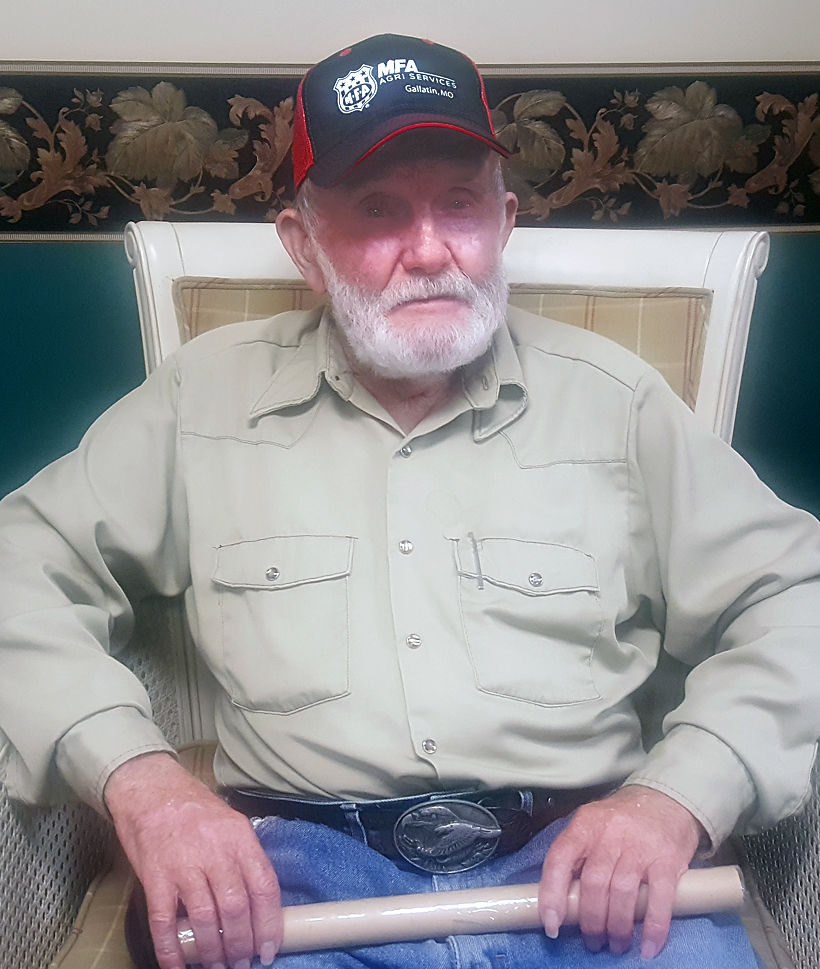
Joe Caraway can tell you several Caraway-family stories that are worth remembering. Like how Joe and Frank Caraway sold Delco light plants before Rural Electric was even around. They wired several grain elevators, Reeds Seeds, K.C. Froman’s, Bob Dixon’s, and an elevator in Polo. Or the story of how Syd Caraway of Coffeyville, KS, was the oldest man to have a pilot’s license in the state. The Kansas City Star did a story about it, but Joe hasn’t been able to find the article online or in any history books. Fortunately, the story about his grandfather George Caraway getting shot during a burglary at Spickard was in all the papers and there is plenty of archived information.