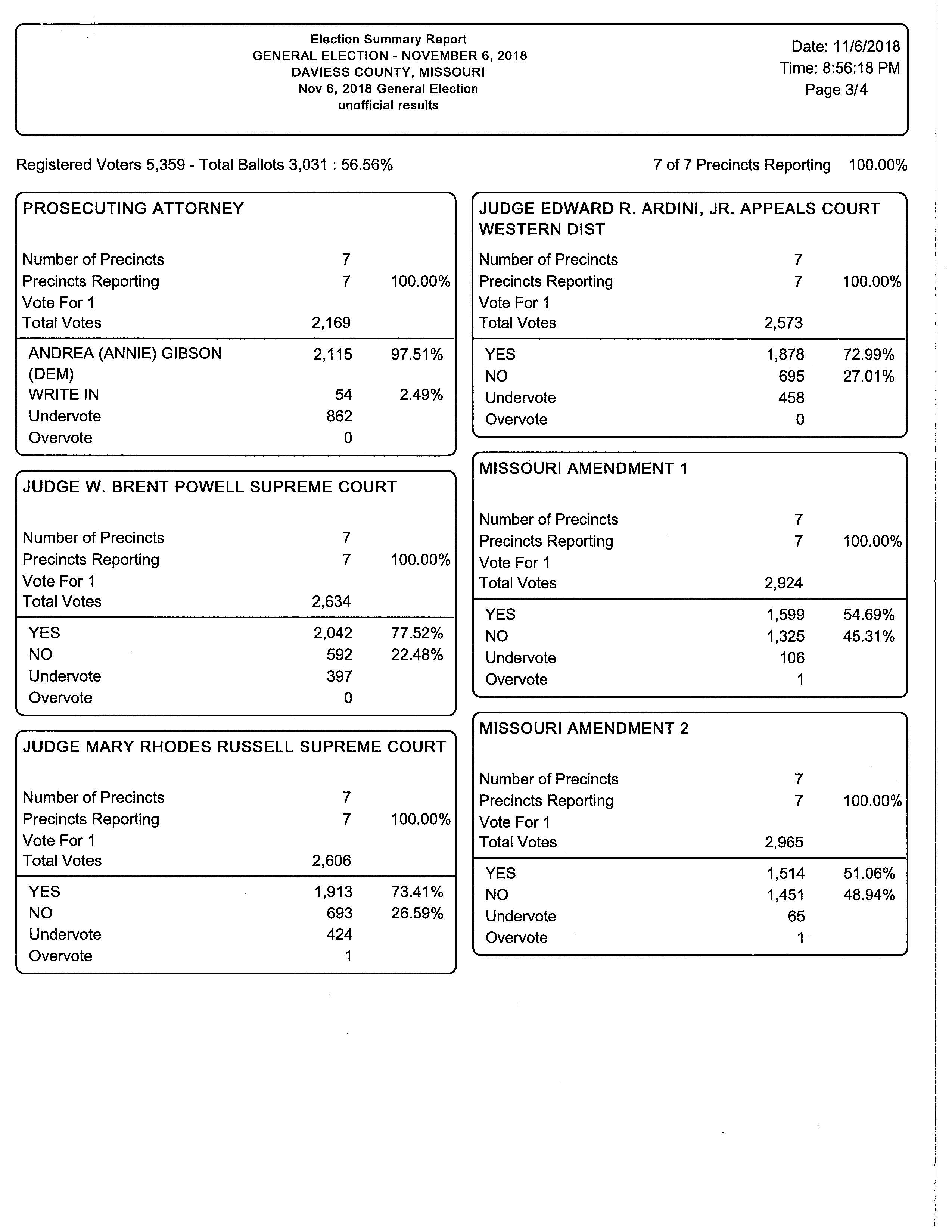
Daviess County voters largely mirrored statewide decisions during yesterday’s general election. The exceptions where county vote totals ran counter to overall election results involved State Auditor and Amendment 4 concerning bingo games.
This website brought to you in part by the following sponsor:

Find out how to advertise here - Email us! [email protected]
The only contested county election yesterday was for county clerk. Republican Ronetta Burton defeated Independent Teresa Eaton by a 668-vote margin. Eaton registered as an independent candidate after failing to declare as a Democrat by filing deadline. Burton was criticized for using “Re-elect” in her campaign when yesterday was her first election victory since being appointed to serve in office.
Yesterday’s election tallied a total of 3,031 ballots cast from the 5,359 registered voters eligible to participate. That is a 56.56% voter turnout.
It may be of some interest to consider the number of write-in votes cast. Seldom do write-in ballots affect an election outcome, but the counts become interesting if write-in votes are interpreted as a token of voter dissatisfaction.
Write-in votes cast for county offices, where winning candidates were officially unopposed, were for circuit judge (61), associate circuit judge (58), prosecuting attorney (54), circuit clerk (34), recorder (30), and presiding commissioner (24). But, obviously, these counts are very small against the total votes cast, and thus may or may not indicate discontent.
Decisions to retain two Supreme Court judges and a judge on the Western District Court Appeals are much easier to discern discontent because the “no” votes jump measurably higher. In Daviess County, ballot results show “no” votes garnered between 22.48% and 27.01% of the votes cast against judges up for retention in office.
Amendments, Propositions
Voters faced a thicket of statewide ballot questions yesterday. Daviess County results mirrored statewide outcomes in all but one instance. While voters locally failed to pass Amendment 4 involving bingo games, voters statewide approved changes. This proved to be the tightest of ballot issues.
Daviess County voters joined others across the state endorsing Amendment 1, called the “Clean Missouri” proposal. This puts a limit on lobbyists’ gifts to lawmakers and includes several provisions to improve transparency in the General Assembly. The initiative petition drew 61.99% support with yes votes at 1,459,576 against no votes at 895,012.
A proposed 10-cent increase in the state fuel tax failed. The current 17-cent a gallon tax hasn’t been changed since 1996 but lawmakers of both political parties expressed concerns about how this proposal would allocate the new revenue.
Three ballot proposals involved medical marijuana, with voters endorsing Amendment 2 by a 65.54% majority. This makes sales subject to a 4% sales tax with proceeds to fund services for military veterans.
The vote was complicated because two other medical marijuana initiatives were on the ballot. Amendment 3 was a proposal led by Springfield physician/lawyer Brad Bradshaw, creating a medical marijuana research institution led by Bradshaw. This proposal received 32% approval.
Proposition C was similar to the now voter approved Amendment 2 but proposed a 2% sales tax and, because it’s a statute rather than a constitutional amendment, the legislature could change it. Proposition C failed, receiving only 43.5% approval.
By passing Amendment 2 Missouri joins 31 states and Washington, D.C., in legalizing medical marijuana. Most other states, including Missouri, allow for cannabis oil with little or no THC, the ingredient in marijuana that produces the “high” that recreational users crave.
Amendment 2 makes doctors the gatekeepers to legal marijuana in Missouri, which is a role most of the state’s major physician groups don’t relish.
Candidate choices
Much focus was thrust on the race for U.S. Senate between incumbent Democrat Claire McCaskill and Republican Josh Hawley. McCaskill, the highest-ranking Democrat in statewide office, fought to retain her seat in a state President Trump won by 19 votes in 2016.
Hawley won the seat yesterday by emphasizing Missouri’s role in national politics. His election helped Republicans hold the majority in the U.S. Senate. Meanwhile, Democrats won control of the House of Representatives, claiming election victories in various states elsewhere in the nation.
Not so in Missouri. Republican Sam Graves easily defeated Democrat challenger Henry Robert Martin. Vote totals show Graves 199,580, Martin 97,515. Graves, 54, has been a Congressman since 2001 and now represents 36 counties across North Missouri. He is chairman of the House Subcommittee on Highways and Transit and member of the Armed Services Committee.
The Tarkio businessman and sixth generation farmer was a heavy favorite. According to the Kansas City Star, Graves’ campaign reported more than $1.6 million in donations with $646,000 on hand in mid-October. This compares to Martin who reported $31,000 in donations with less than $5,000 on hand just before the election.
Hawley’s victory means the Democrats now hold just one statewide office. Democrat Nicole Galloway won a close race against Republican Saundra McDowell. Galloway, a 36-year-old certified public accountant, was serving as Boone County treasurer when former Gov. Jay Nixon appointed her after Auditor Tom Schweich took his own life.