
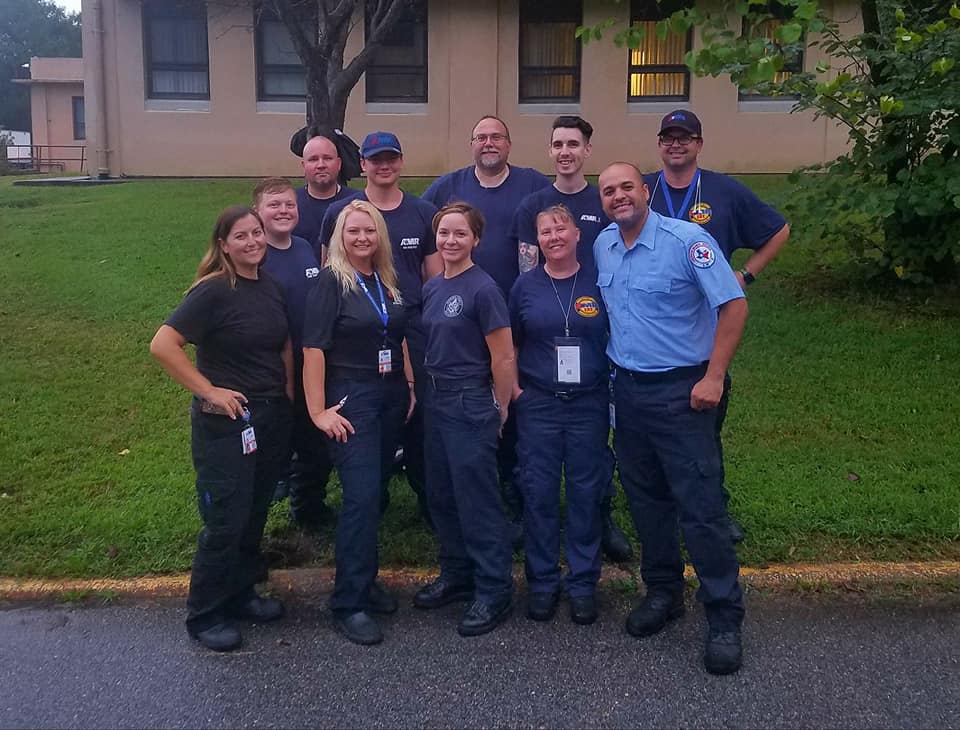
David Roll is in back row center.
This website brought to you in part by the following sponsor:

Find out how to advertise here - Email us! [email protected]
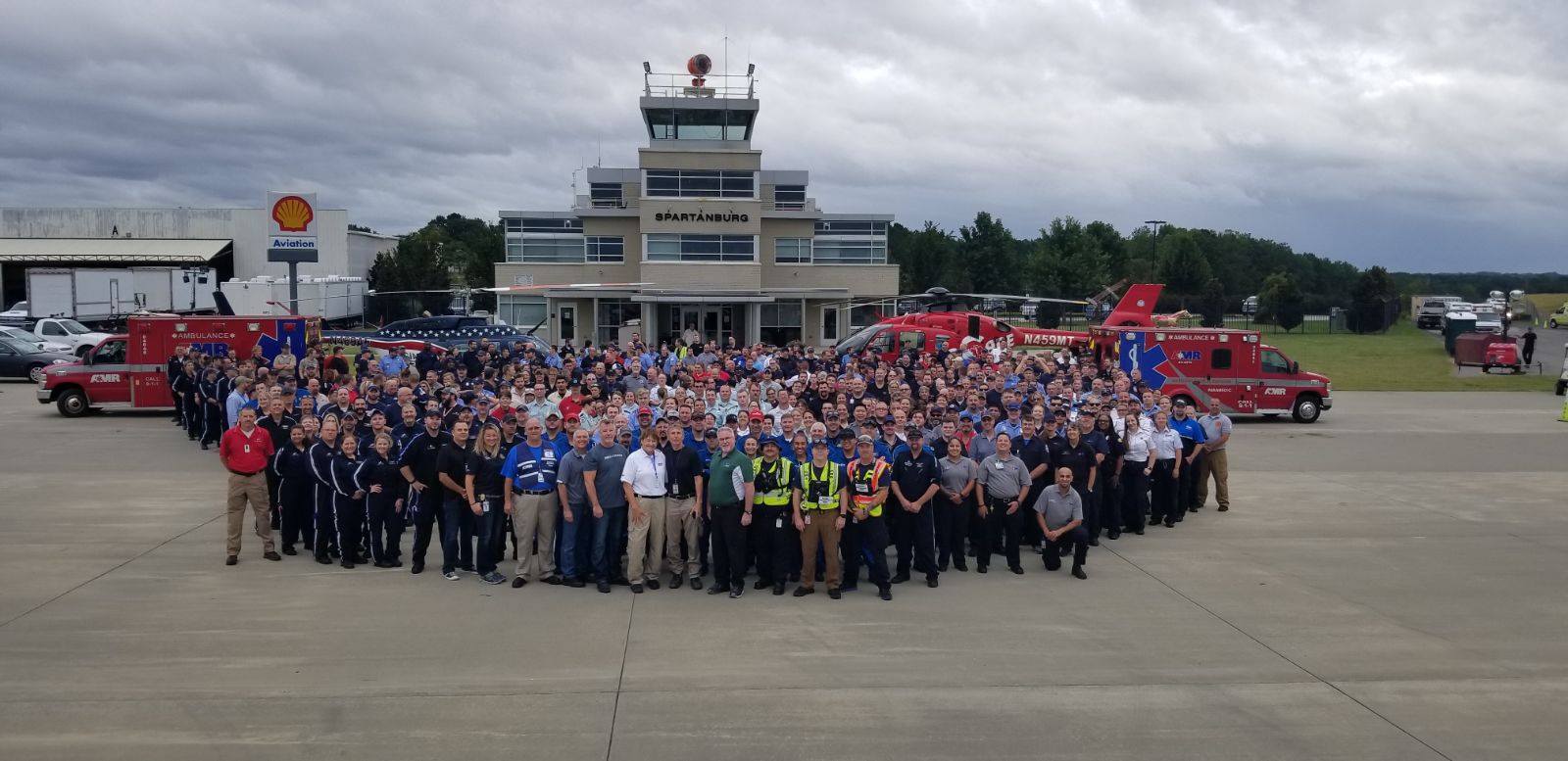
Picture from American Medical Response
David Roll, Daviess County’s Emergency Management Director, was deployed to Virginia in preparation for the aftermath of Hurricane Florence. But, fortunately, emergency services were not needed in that state.
The Category 5 hurricane was due to strike the east coast with catastrophic flooding, tropical-storm force winds, and massive amounts of rainfall.
“I felt better prepared after last year’s experience with Hurricanes Harvey, Irma and Maria,” said David, who spent a 28-day hurricane deployment in 2017 with most of his team’s assignments in Texas and Florida. “Things were very rushed this year with lots of standby and stand-downs in the days leading up to deployment, which in of itself is very stressful.”
With sendoff messages of “Good luck” and “Safe travels” from his friends in Gallatin, David deployed on Sept. 11 to arrive at the American Medical Response (AMR) Office of Emergency Management (OEM) operation in Stone Mountain, GA, outside of Atlanta. There, they were divided up between paramedics and EMTs. The majority of paramedics coming into Stone Mountain were either sent to Virginia (like David and his coworker) or stayed at Stone Mountain.
“The intention was to have us operate in what is know as ‘fixed sites,'” David explained. “Fixed sites were evacuation centers and shelters to support doctors and nurses, who would also be sent there.”
David took a nine hour bus ride to Fort Lee, VA, just outside of Richmond. He spent the night there. The next day he arrived at an army base at Fort Lee, VA. David, along with several hundred first responders, paramedics and ambulance operators from across the country, loaded the ambulance with supplies and headed up to the aftermath zones.
“We were staged in Virginia awaiting assignments when the storm turned and headed west and not north as first predicted,” David said. “Therefore, there was virtually no impact to Virginia and our services were not needed.”
Florence left at least 32 people dead in storm-related incidents — 25 in North Carolina, six in South Carolina and one in Virginia. About 500,000 homes and businesses are still without power, mostly in North Carolina but some in South Carolina. Florence was quickly downgraded to a tropical storm and is now a tropical depression, but its rainfall of 24 inches set a record for a hurricane, surpassing 1999’s Hurricane Floyd. The National Weather Service warned that flash floods, landslide warnings and “prolonged” and “significant” river flooding will continue for the next few days.
David was deployed and arrived back home on Sept. 15.
“Fortunately the impact of Hurricane Florence was not as large as had been anticipated,” he said. “So for now, laundry has been done, bags repacked and made ready for the next adventure. It is back to business and life as usual.”