Editor’s note: The following continues details (first published in January, 2018) about a neon Ford sign at the former Swofford Ford dealership of Gallatin.
This website brought to you in part by the following sponsor:

Find out how to advertise here - Email us! [email protected]
Besides the search for my sign’s path of ownership, I’ve also been conducting a parallel search into the sign’s origins, i.e. who made it and what if any significance there might be. Turns out there’s definitely some significance to it. There’s a whole other story regarding this that has proved to be very exciting for me. I’ll give you a few details below and if you think any of your readers would be interested, say the word and I’ll compile my results for publication. I’m highlighting three main categories but there are actually more than that.
The Teal Oval Ring:
I didn’t belabor it in my previous stories but the one thing that made this Ford sign “different” from all others, different enough to excite the auction house (and everybody else who’s seen it), is that it’s the only known “3-Color” Ford sign/logo ever sanctioned by the corporation. The blue oval Ford logo we all recognize was officially adopted by Ford in 1927 – there were actually four other logo styles previous to it from Ford’s inception in 1903. This familiar blue oval logo consists of a blue background, white Ford script lettering, and a white oval perimeter ring. My sign on the other hand has the blue background and white Ford script, but the oval ring isn’t white, it’s teal in color. Anyone who’s had any involvement in advertising or marketing knows that you most definitely DO NOT mess around with a client company’s corporate identity or logo. Whoever made this/these signs for Ford obviously had Ford’s blessing. You know that a lot of convincing to the Ford top brass had to happen and the result is that the trust Ford found in the sign maker’s salesmanship was successful. At least for a little while. The big question remaining is “why” – why the sign maker felt it necessary to suggest this change in the first place. All I have now is a plausible theory but nothing concrete. Yet.
The Sign’s Producer:
My sign has a small maker’s mark embedded in the porcelain face – a common practice by porcelain enamel sign producers. The early 1900’s marked the beginning of the shift from local to nationwide distribution of products made by growing manufacturing concerns and thus marked the beginning of national advertising efforts. Sign makers put their identities on their products to help attract new national clients. “Federal Brilliant Co. – Saint Louis Mo.” was the maker of my sign. No internet search has yielded a thing about them, however, my decades long involvement in the sign industry gave me a possible clue to investigate. Federal Electric Sign Company of Chicago was the first electric sign producer in the United States beginning in 1901. They still exist and are headquartered in Euless, Texas. An archivist there found out that indeed there was a connection between the two sign makers that shared the name “Federal”. Federal Electric Signs of Chicago bought the Brilliant Sign Company of St. Louis in 1930 and promptly renamed it Federal Brilliant Company. The significance of this is that Federal Electric Signs of Chicago was THE company that raced over to France to secure the foreign patent rights from George Claude (inventor) to produce neon signs in America. Could it be that my sign may have been among the first neon signs made in America?
The Sign’s Date of Manufacture:
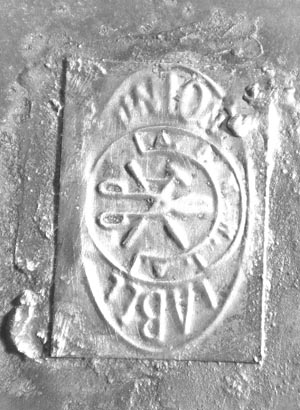
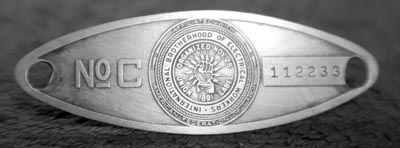
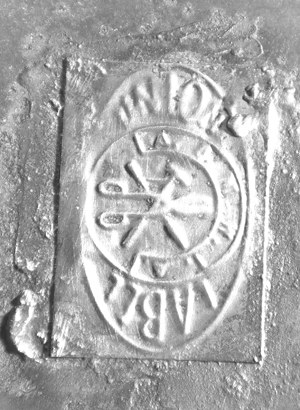
My sign has two small brass union labels attached to it. A brass “A.S.M.W.I.A.” label is soldered to the bottom of the can (Amalgamated Sheet Metal Workers International Alliance). Another brass label “IBEW” is fastened to the side – “International Brotherhood of Electrical Workers – Local #1” (this was the first electricians union in the states chartered in 1891 – in St. Louis). The IBEW label has six numbers stamped in it – 112233. After consulting with officials at IBEW Local 1, they concur that the union had no interest in a product’s serial number – that this was more likely the build date. It so happens that November 22, 1933 was a Wednesday. The day before Thanksgiving – at the depth of the Depression.
With all of this evidence so far, it seems very likely that my sign which was made in 1933 (seven years into their patent deal with Claude) would have occurred before Federal Electric’s exclusionary patent rights expired. [A U.S. Patent (4,765,102) awarded to me in 1988 had a 17.5 year life.] At this time, I’ve got the folks at Federal Heath searching to find how long they did indeed enjoy the rights to neon production. And unless Federal licensed neon production to someone else before they lost the rights to expiration, I think it’s safe to assume that my sign fell within their effective patent lifespan. And if that’s true, Ford (and everybody else) had no other choice for neon but to go to Federal – there was no one else legally capable to produce it. And who else but the largest recognized leader in the electric sign industry would have to clout to suggest to the largest recognized leader in automobile production to alter their logo for whatever reason? It’s looking like my sign may indeed be among the first and only neon signs available to Ford at the time. ?
Like I told Phil, John, and Macon, all I wanted 37 years ago was a Ford sign — period. I noticed the teal ring then but never dwelled on it. Who knew it would lead to this adventure? And to think I almost lost it forever.
Chris Kuchem,
ph: 913.244.3322 or email [email protected]