Lingering economic malaise New Normal for 55 Missouri counties
May 9, 2018 | Regional News |
A statewide survey was recently conducted by Missouri Rural Development Partners with the hope it would offer information about key issues, such as the economy and workforce, infrastructure and leadership, housing and health.
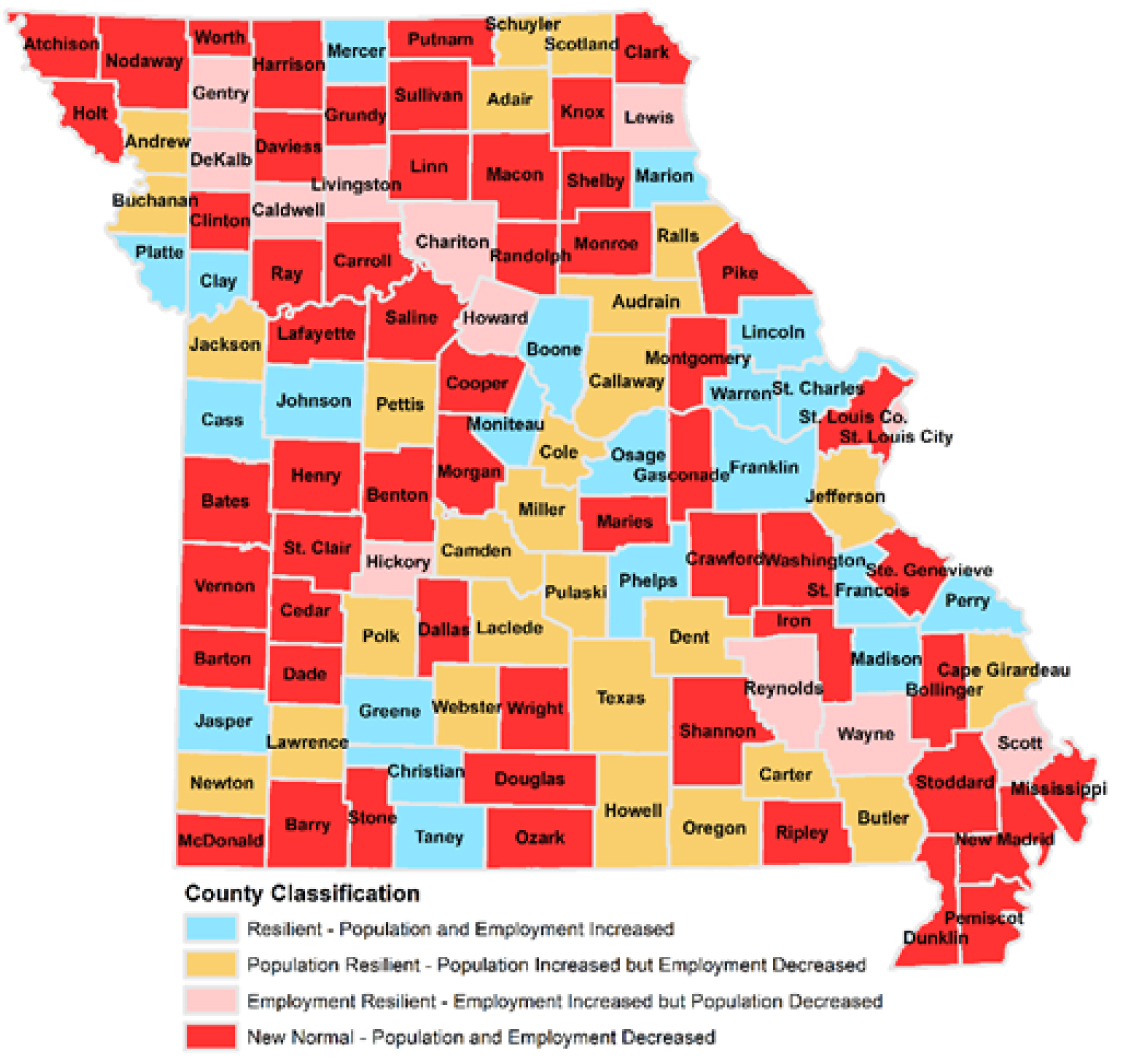
The 2017 survey was launched against a backdrop in which 55 counties, including Daviess, have not returned to the employment and population levels of 2007….and possibly never will.
The term New Normal has been widely used in the wake of the Great Recession to refer to places and businesses that may have permanently changed as a result of the recession, which officially lasted from December 2007 to June 2009.
The average losses for population for these New Normal counties were -3.7% and jobs -9.5%.
Methodology
An important goal of the distribution effort was to put the survey in front of community leaders. This goal was successful as 83% of respondents were engaged in some type of community organization. A large proportion (31.3%) served on boards or had been an elected official. In total, 2,261 valid responses to the survey and nearly 8,000 written comments were received.
The largest number of responses came from Vernon County (96) followed by Howell (70) and Taney (50), these were the only counties with 50 or more responses. Thirty counties had less than 10 responses.
Daviess had 13 respondents, and surrounding counties: DeKalb 5: Clinton 21; Caldwell 12; Livingston 9; Grundy 14: Harrison 17: Gentry 32; Linn 47.
The survey was conducted as a “convenience” survey. That means that it was open to anyone who had access to the survey and was willing to take the time to respond.
Population
One of the key indicators of a growing and prosperous economy is population growth. People are the drivers of economic development.
In the 2007 to 2016 period Missouri grew at less than one-half the rate of the US, 3.5% compared to 7.3% for the nation.
Forty-seven of the 59 rural counties lost population. (Rural counties are distinguished by the lack of a large commercial center of 10,000 or more population.) The indicators are even worse when examining the 2010 to 2016 “recovery” from the recession. Eighty counties are estimated to have lost population since 2010.
Change in full-time jobs between 2007 and 2017
Employment growth indicators are equally troubling. All groups of counties except Metropolitan (counties with at least one city with 50,000 people); have experienced net job losses.
Eighty-two of Missouri’s counties have fewer jobs in 2017 than they had in 2007.
The losses in rural counties equal -7.1%.
There are 59 rural counties in Missouri. Not all rural counties experienced job losses. Notable exceptions are Perry, Howard, Hickory, and Madison counties with growth rates that exceeded the national rate of 4.8%.
Categories for counties
For the survey’s purposes, Missouri counties were assigned to four categories based on changes in employment and population between 2007 and 2017.
*Resilient counties experienced growth in both population and income, 21 counties are in this group.
*Population Resilient counties are those that experienced population growth but have not recovered to 2007 employment. This group of 27 counties is the most diverse with counties from all of the categories.
*Employment Resilient counties have recovered to 2007 employment but lost population. Rural counties dominated this group with Howard (+8.6%) and Hickory (+8.3%) posting the largest employment gains. The average employment growth was 3.3% while population losses averaged -2.7%. Gentry, DeKalb, Caldwell, and Livingston belong to this group.
*New Normal counties have experienced losses in both population and employment. Forty-one of the 55 counties are rural and only one is Metropolitan (St. Louis County). Daviess, Clinton, Grundy and Harrison belong to this group.
Community Planning
One of the more striking findings from the survey was the degree to which respondents disagreed with the statement “My community is doing just fine and doesn’t need to change.”
Respondents from New Normal counties, like Daviess, had significantly larger proportions that expressed concerns about their communities: 85.8% disagreed with the statement that “My community is doing fine and doesn’t need to change”. Only 44.6% believe their community is forward looking. Only 25.3% believe they have a clear plan for the future.
How welcoming and cohesive a community is can have a powerful influence on growth and development. Places that are welcoming and care about the quality of life for all residents will have an advantage over places that do not embrace these values.
New Normal county respondents are consistently below other groups — 56.3% believed that new residents feel welcome, compared to the overall rate of 59.9%;
And 65.7% indicate residents take pride in their communities, compared to 77.7% in resilient counties.
Affordable housing
Affordable housing is an emerging issue in the State.
New Normal counties were significantly more likely to have concerns about housing. 49.4% of respondents from these counties thought affordable rental housing was a concern and 40.4% were concerned about affordable single family homes.
The ten percent gap in the perception of rental housing affordability illustrates the likely impact of economic hardship and low income profiles in New Normal counties.
Developing Infrastructure
Developing and maintaining infrastructure is one of the key responsibilities of local government.
Counties experiencing the greatest economic hardship were more likely to express a high level of concern about the capacity to afford infrastructure costs. In New Normal counties 66.7% were concerned about these costs.
Access to broadband internet services is a hot topic right now. It is critical to the local economy – businesses need it to handle transactions, schools need it to ensure student access to education opportunities, hospitals and doctors use it to provide access to healthcare.
One of the most surprising findings in the survey was the relatively small proportion of respondents who thought access to broadband was a problem, only 41.7% expressed this as a concern.
One explanation for the lower than expected level of concern are the characteristics of respondents. With a more highly educated, slightly older, respondent pool it was surmised that many are able, personally or professionally, to broadband and have the personal resources to pay higher fees for good access.
Leadership
Recruiting leaders is a problem in many communities.
Although rural respondents were similar to the total on the question of opportunity (60.5%) they had a higher level of concern about the willingness of people to volunteer and lead (69.1%).
In New Normal counties, 51.1% of respondents approved of elected officials performance.
The Economy
Ensuring a stable and resilient local economy is the goal for most communities. The impact of the Great Recession left many communities and counties struggling to return to their perceived normal.
Rural Missouri has higher poverty rates and lower incomes than the rest of the State and respondents from those counties recognize that reality. 72.8% of rural respondents thought poverty had increased compared with only 58.6% in Metro Central counties where poverty rates are lowest.
In the New Normal counties, only 13.2% thought living wage jobs were available, and only 23.4% thought the economy would improve in the next five years.
Only 14.5% of New Normal county respondents think enough is being invested in business development and an equally small proportion (13.8%) think there are enough employment opportunities.
Differences based on the economic performance of counties follows the trend in previous questions with New Normal county respondents less likely to believe the community supports local business, the same was true for downtown maintenance.
Only 57.2% of respondents from New Normal counties thought the community supported local businesses and 52.5% of New Normal respondents think downtowns were well-maintained.
The Workforce
Workforce quality is a top tier issue in economic development. The availability of a ready to work labor force with the right skills will often determine winners and losers as businesses make location and expansion decisions.
The survey included two questions addressing workforce issues. The first asked respondents to assess whether workforce skills match local employer needs. The second question asked about the availability of workforce training programs.
In New Normal counties 30.6% of respondents agreed that workforce skills matched employer needs.
For the question concerned with access to training, New Normal counties had 24.5% agreeing with the statement that training is available.
Health Care
Missouri gets relatively low scores on many state rankings of health and health care systems. The State ranked 40 in the United Health Foundation America’s Health Rankings 2017.
When responses are compared based on economic indicators, the respondents from New Normal counties were less likely to think health care services are available (77.9%) and also believed that there are fewer health care professionals available than are needed (58.5%).
When counties are compared based on economic indicators there are few differences in response to the question about prescription services. New Normal counties were more likely to think access to mental health and substance abuse resources were missing with 37.3% noting mental health services were not available and 36.9% for substance abuse programs.
There was widespread agreement that senior services, housing and residential care facilities are available. 72.1% of respondents agreed there is access to senior centers and services. An even larger 74.3% indicated there were senior housing and residential care facilities.
Comments
Responses to the question ‘if you could wave a magic wand to change just one thing in your community, what would it be?’ were diverse and often addressed specific issues relevant to the place of residence but fell into four major themes. The economy dominated these comments with 47% of all respondents wishing there were more jobs and economic opportunity for residents.
Executive Summary