by Darryl Wilkinson
This website brought to you in part by the following sponsor:

Find out how to advertise here - Email us! [email protected]
While thumbing through a bound volume of newspapers in the archive on shelves in our break room, Dennis Cox came across a short news article about Robert G. Black. Without question, Commander Black should be included on the list of Daviess County citizens of historical significance in military service to our country.
The 1935 graduate of Gallatin High School is cited as the first Naval officer to command the first nuclear submarine division in history. A more detailed account of Capt. Black’s military service is provided below.
Until now, and despite publishing his obituary in 2008, perhaps Capt. Black has been overlooked. When Dennis posted the find on Facebook, it attracted some comment which we’re still attempting to verify.
Some say Capt. Black was the brother of Betty (Mrs. Bob) McClelland. The Black family may have lived in Winston at one time; the Captain’s mother, Mrs. Erma Black, may have lived on East Grand Street in Gallatin after her husband passed away.
The internet makes researching Commander Black’s military achievements comparatively easy. East Carolina University hosts a manuscript collection of papers from Commander Black (1942-43, 1962-72). The abstract of papers from this U.S. Navy officer includes original memos, reports, newsletters, photographs, a certificate and photocopies of war patrol reports and maps for the USS Flying Fish during World War II.
Only one image from this collection has been digitized — a Presidential citation for Capt. Robert G. Black’s “Outstanding Meritorious Service” from 1966-1969.
As I write this, we have only one photograph of the captain which was printed in April, 1958, when Capt. Black was placed in command of the nuclear submarine division (please excuse the reprint quality). Hopefully, more photos will become available after contacting family descendants.
Remembering someone historically can seem rather sterile. Although this time frame is not too far in the past, it’s already a puzzle to get the true measure of the man.
The Gallatin Democrat listed Glenwood Black as one of 54 graduates in the GHS Class of 1935, when school board president, Attorney Dean H. Leopard, presented diplomas during commencement ceremonies held at Gallatin United Methodist Church. You can’t help but wonder, what hometown memories did he have?
Like so many others, young Mr. Black left his hometown to pursue interests elsewhere. Records show he attended the University of Tulsa (1936-38) and then graduated from then Louisiana State University with a B.S. degree in Petroleum Geology in June 1941. He immediately entered the U.S. Navy and was commissioned in the U.S. Naval Reserve.
Six months later, America plunged into World War II and, along with the other men and women of America’s Greatest Generation, Black’s life dramatically changed. So far, there is little evidence that he ever returned to Gallatin for any extended period of time.
North Carolina became his home. This is where he once attended graduate studies at NC State University. This is where he met his wife, Jane Forbes Black, who shared close to 65 years of marriage. This is where he is buried.
Following his retirement from the Navy, he joined Data-Design Laboratories in Virginia and later moved to Greenville, N.C. He was active in community affairs there — the Greenville Rotary, Jarvis Memorial Methodist Church, treasurer of the Friends of Jarvis Memorial Library.
But even the best written obituaries are often lacking.
Achievement lists are fine, but not the only measure. Every person has a unique story.
Sometimes those most deserving to be remembered are those who excel in the most common ways … moms who made the best fried chicken and gravy, an uncle who could fix anything, a cousin who loved to ride roller coasters, a friend extravagant in sharing her time, a dad who took you to a football game, the jokesters, the birdwatchers, the fantastic dancers, the 10-point Pitch champs, the oddball collectors … We grieve over those who knew just what to say and those who didn’t have anything to say, and others so easygoing you didn’t see them coming.
We don’t really know where Commander Black fits into the scheme of such things. There is no question, however, about including Commander Black on a list of local boys who excelled in the military serving this country. It is impressive to consider his contributions during WWII and beyond into the nuclear age. And we are extremely thankful. And proud.
Capt. Robert G. Black (1917-2008)
Robert G. Black, Sr., was born on Oct. 22, 1917, in Gallatin, MO, where he later graduated from high school in 1935. After university studies at Tulsa, OK, and Louisiana State University (graduating in June, 1941), he immediately entered the U.S. Navy and was commissioned in the United States Naval Reserve.
He attended Midshipman School, Northwestern University, and graduated in 1941. Beginning in 1943, he served aboard submarines in the Pacific during the Second World War. He made nine war patrols in the Pacific Theatre during the war, serving on the submarines Flyingfish, Batfish and Guitarro. Black skippered two submarines, the Flyingfish and Sablefish.
During 32 years of service to his country in the United States Navy, Bob was assigned to several submarine duties that included assuming command of the Navy’s first nuclear submarine division in 1957.
At that time the U.S. Navy’s three commissioned atomic submarines were assigned to Sub. Division 102: Nautilus, Seawolf and Skate. These nuclear submarines joined with the diesel-powered submarines Hardhead, Bang and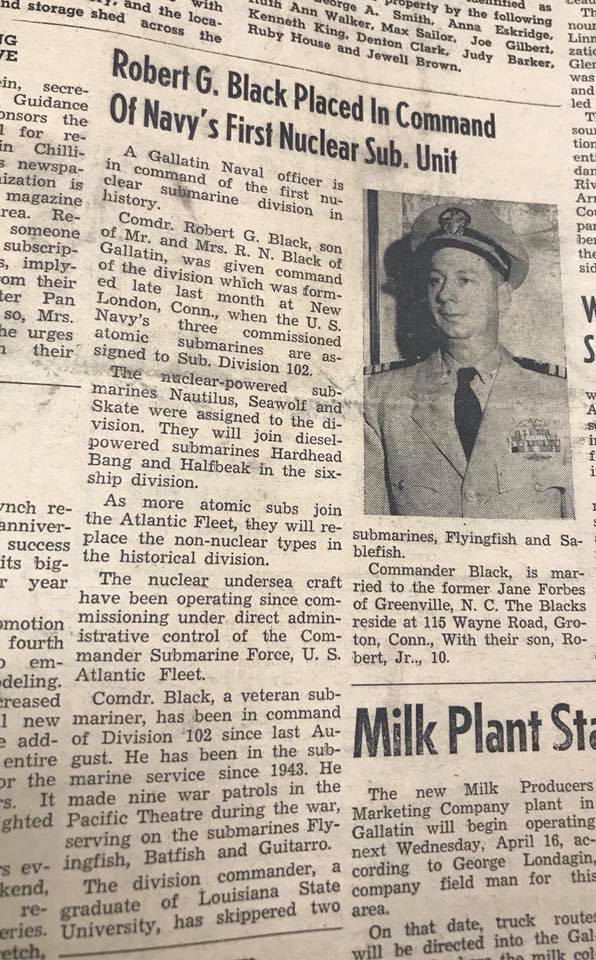
 Halfbeak in the six-ship division under Commander Black.
Later in his service, Capt. Black commanded the USS Hunley (AS 31) in Holy Loch, Scotland, then commanded Submarine Squadron Four in Charleston, S.C. and assumed command of the U.S. Naval Station in San Juan, Puerto Rico. He retired from the United States Navy in May, 1972.
His naval career was distinguished and was recognized through being awarded several decorations and medals that included the Silver Star, Gold Star in lieu of Second Silver Star, Bronze Star with Combat V, Gold Star in lieu of second Bronze Star, Navy Unit Commendation, Submarine Combat Insignia with eight stars, American Defense Service Medal, American Campaign Medal, Asiatic-Pacific Campaign Medal (three stars), European-African-Middle Eastern Campaign Medal, World War II Victory Medal, National Defense Service Medal (one star), and Philippine Liberation Ribbon (one star).
Captain Robert G. Black, Sr. died on July 8, 2008. At that time he was preceded in death by a brother and a sister. He was survived by his wife, Jane Forbes Black, of Greenville; a son Robert G. Black, Jr., of Raleigh; a sister, Kathleen Black Beckworth of Little Rock, Ark., and one grandson.
The following are others of historical significance when discussing those from Daviess County who served in the military:
Major Samuel Cox … Civil war Union leader & Jesse James survivor
Rear Admiral Richard Cruzen (GHS ’14) … second in command of Antarctic expeditions
USN Capt. Robert G. Black (GHS ’35) … America’s first nuclear sub division commander
USN Jesse Reynolds & Jub Tomlinson … Pearl Harbor survivors from Gallatin
USN Capt. James A. Schreckengaust (PHS ’54) … Indian Ocean sea lift command
USAF 2-Star Gen. Dick Paul (GHS ’62) … commander Wright-Patterson AFB
USAF Brig. Gen. Jim Sears Jr. (GHS ’87) … commander of 455th Air Expeditionary Wing