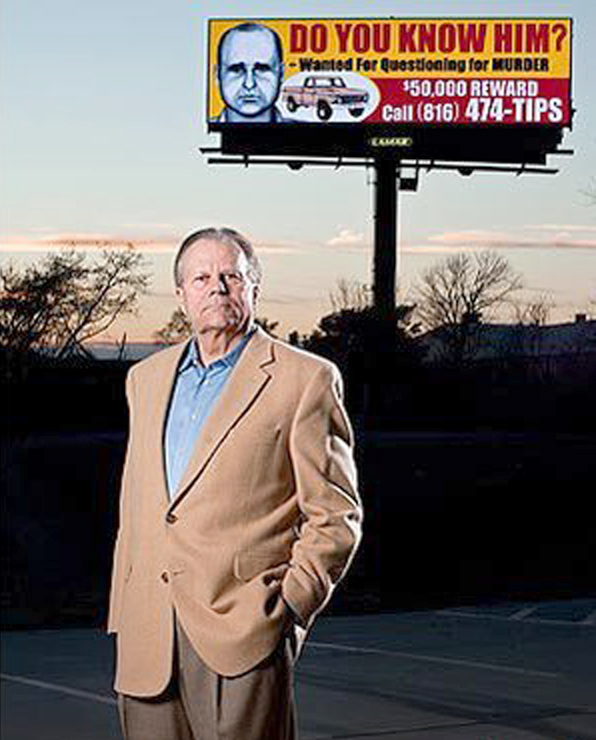
Ali Kemp fought hard for her own life, now she fights for others
Apr 4, 2018 | Community News |

In 2010 Roger Kemp was nominated for the Presidential Citizens Award, presented by President Obama. His other recognitions include: Pi Beta Phi National Sorority Presidents Cup; State of Kansas Parks and Recreation Paul Harris Fellow-Rotary: National Volunteer of the Year-Rotary; Leawood Kansas Appreciation Award; Kansas City, Missouri, Police Department; Distinguished Kansan; F.V. Heinkel Award of Excellence-Shelter Insurance, Columbia. Roger Kemp began his business career in 1973 as a self-employed manufacturers’ representative and entrepreneur. He has invented, brought to market and sold numerous pieces of equipment associated with the plastic extrusion industry.
Trenton Police Chief Tommy Wright and Green Hills Women’s Shelter presented the Sixth Annual Chief’s Tea on March 23 at the First Christian Church in Trenton. Roger Kemp was the keynote speaker.
Mr. Kemp’s world was turned upside down in 2002 when a stranger viciously murdered his young, beautiful daughter, Ali. Since then he has worked tirelessly to bring his daughter’s murderer to justice.
He came up with a new, eye-catching way to catch criminals — billboards. The billboard campaign has apprehended fugitives by the hundreds.
He also started a defense program which has trained over 67,000 girls and women ranging in age from 12 to 90.
During the Tea on March 23, Mr. Kemp told the story of how his introduction into a “new world” came about….
Roger Kemp, a native of King City, along with his wife Kathy and three children, Alexandra, Tyler and Drew, lived in Leawood, Kan. Leawood is a quiet suburb of Kansas City. Roger describes it as “the safest place in the world.”
His daughter Alexandra, or Ali, as she was called, was 19 and a freshman at Kansas State University. She had graduated from Blue Valley North High School. In both high school and college, Ali was involved with sports and numerous activities; she was an honor student and a member of Pi Beta Phi Sorority; she was a volunteer in her church and community.
“She was a wonderful daughter,” says Roger.
Home from college for the summer, Ali worked at a local pool. The pool, located on State Line Road, was only a few blocks from her home. It was a windy, cloudy day, with the temperature in the sixties on June 18, 2002. It was chilly and nobody was swimming at the pool. Ali was there by herself.
Later in the morning, her brother Tyler went to the pool to take over the pool shift from Ali. He saw her things — a cell phone and purse — but he couldn’t find her and called their father.
Roger then went to the pool. He looked around the pool and inside the pump room, which was dark. Behind the pumps he saw a tarp. He took off the tarp. There was Ali.
Roger is not able to describe what he saw, except to say Ali fought hard for her life:
“There was a terrific struggle,” he says.
Later he would be told that Ali had been confronted by her attacker in the pool’s pump room. She was beaten and strangled.
The act of senseless violence would stun the community and even the veteran metropolitan police officers. The next day the officers would tell Roger they were looking for a “subhuman, a trophy hunter.” He had taken Ali’s necklace and an undergarment.
There was a witness. A friend of Ali’s had driven to the pool that morning to hang out with her. She’d honked, but when Ali did not show up, she supposed she’d gone off on an errand, and so the friend went back home. However, before leaving she saw a man carrying a bucket around the pool. She saw him get in his pickup and leave. She thought he was a maintenance man. She would be able to provide the police with a composite sketch.
Later, the friend would be traumatized by what happened to Ali, and that she had not done anything to help her. The police told her that if she had tried to help, there would have been two dead girls under the tarp.
A break in the case came from a Mexican worker who was mowing grass near the pool. He saw a pickup circling the pool area. Even though he was an undocumented worker, he still went to the police with a description.
The police fanned out looking for clues. They left no stone unturned.
“I don’t know how anybody could criticize the police if they saw what they were doing,” says Roger. “They looked in old vehicles and refrigerators, everywhere. They wanted to catch this guy.”
Roger says the citizens of Leawood immediately adopted Ali as their own.
“All denominations were praying for us,” he says. “It kept us going.”
Even the people of the inner city, who “considered it worse to snitch than to commit murder,” supported Roger and wanted to help.
Truckers took flyers out of Kansas City in every direction.
The police included Roger in all they did, but after eight months, Ali’s killer was still not caught.
“We wanted to keep it in the public eye, or it would turn into a cold case,” says Roger.
He tried everything, including asking the local movie theaters and shops to put up flyers. But the theaters and shops thought it would be bad for business. He took out a half page ad in USA Today.
One day Roger was driving down the road and looked up and saw a billboard.
“There was no great explanation for why I got the idea,” he said. “I thought, why not.”
He asked Bob Fessler of Lamar Advertising, which owned the area billboards, what a billboard would cost.
Once Lamar Advertising knew what Roger wanted the billboard for, to generate leads and catch the man who killed his daughter, the company insisted on doing it for free. They put up several.
“To this day, I don’t know what it costs to buy a billboard,” Roger says.
The billboards were posted with the police artist’s sketch of Ali’s killer. About 50,000 eyes saw each billboard every day. The response was immediate. Leads flooded in.
Roger did a story with John Walsh on America’s Most Wanted.
He would be on the show four times.
“We thought 50 times we had the guy,” Roger says.
The police admonished Roger to “not do anything stupid like go after him.”
The police were looking at DNA and taking tips from all over the country.
Then one day the police got a lead from the east coast. Three detectives left for Bantam, Connecticut. They were following a tip from someone who had seen the billboards.
“I knew this had to be it,” says Roger. “They’d never sent three detectives before.”
Two years after Ali’s murder, in November 2004, her killer, Benjamin Appleby, then 29, was arrested in Bantam, 1,300 miles away. He was living with a girlfriend under an alias.
Appleby would make a taped confession in which he described cornering Ali in the pool’s pump room.
Despite the confession, Appleby pleaded not guilty. The trial would drag on for another two-and-a-half years.
Eventually Appleby would be found guilty of capital murder and attempted rape. He had owned a pool maintenance business at the time and had gone to the pool to check it out as a potential client. He had “hit on” Ali and then “lost it” when she rebuffed his advances. He was sentenced to life in prison with no chance of parole for 50 years.
Ali’s murder would haunt her father. It would have deep and wide repercussions, not just for the family and community, but for those involved on the edges.
Appleby had prior altercations with law enforcement. He had been arrested several times in Missouri and was convicted on felonies that included second-degree robbery and second-degree sexual misconduct.
Appleby had a double-barreled shotgun during one of the robberies he committed. A police officer had him in his sights, but decided not to shoot him.
“Every June that police officer becomes an alcoholic,” says Roger. “He wishes he had shot him. He would have saved Ali. I tell him not to feel that way.”
Through his ordeal, Roger has learned not to have preconceived notions about people because, often, they did unexpected things, including the reporters covering the courthouse.
During the trial, Appleby’s father constantly circled Roger and taunted him. Roger ignored him. Until one day he went too far.
“I went after him,” Roger says. “It was the news reporters that jumped between us. They said, don’t do it, he’s not worth it, and I’d be barred from the court if I did it. I was impressed that they did that. It would have looked good on the news.”
The strategy of using billboards as “wanted” posters to catch killers proved amazingly successful and has been adopted by law enforcement agencies across the United States, including the FBI and the series America’s Most Wanted.
But it is not the only campaign Roger has launched on Ali’s behalf.
He has started a self-defense class for women and children. The Ali Kemp Educational Foundation and its T.A.K.E. defense program teaches women how to escape a close-quarters/confined attack. Ali fought hard for her life. Roger believes she might have been able to escape if she had taken a class like it.
“Again and again, female victims say ‘I don’t know why he picked me,'” said Roger. “In any given class of 40 women, at least three have been sexually assaulted.”
Roger says it’s not about women being afraid, only aware.
Besides America’s Most Wanted, Roger has appeared on The Montel Williams Show, Twenty Twenty, Prime Time, Dateline, Paula Zahn, Real TV, Huffington Report, Crime TV and People Magazine.
After his daughter’s murder, Roger found himself thrown into a world of law enforcement and news media he knew nothing about.
“I’m from King City,” he says. “So you know I have values. There was no way I was going to let a predator get away with taking someone from my home. There’s nothing more important than our women and children. They have a right to live life to the fullest.”
Roger says the biggest thing he fights is the mindset — that it happens to somebody else.
“It happens to the women who have hopes and dreams, who love and who are loved … not to somebody else,” he says.
To date, 67,000 girls and women have taken the class.
“Someone told me after Ali was murdered that it was horrible, but it happens,'” says Roger. “I don’t want to accept that it happens. I want to put a stop to it.”
The Green Hills Women’s Shelter in Trenton provides residential and non-residential support to men, women and their children. Service areas include Daviess, Clinton, DeKalb, Caldwell, Harrison, Grundy, Livingston, Mercer, Putnam and Sullivan. The Shelter will build a new facility at 315 Johnson Drive and is currently seeking sealed bid proposals. The building will encompass 8,500 square feet and will have double the capacity and double the bed space of the old facility. There will be room for onsite counseling, an education wing, and many improved security features.