
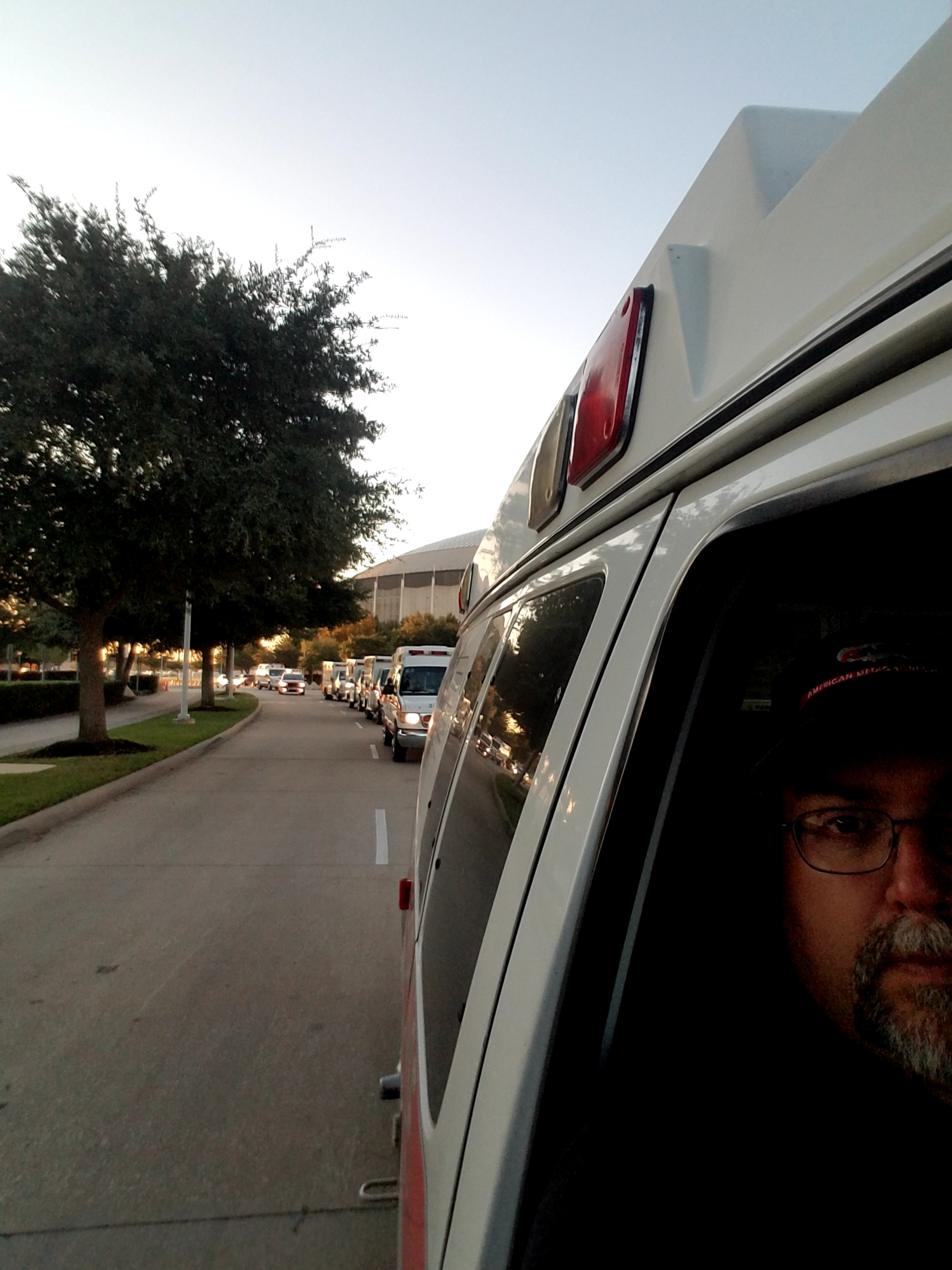
 David Roll, the Emergency Management Director for Daviess County, has returned from a 28 day hurricane deployment, with most of his team’s assignments in Texas and Florida. During that time, he missed his daughter Briar’s coronation at the Homecoming game on Sept. 22 and also celebrated his birthday away from home and loved ones.
But life is full of the unexpected, as everyone knows, he noted on his Facebook post, and his wife Laurie and his daughter Briar have been very supportive.
“Both of them have told me they are proud of what I am doing which means the world to me,” David says.
David served as a paramedic for 24 years and is currently employed full-time as a paramedic with American Medical Response, (largest ambulance service in the United States) which has a Missouri Operation headquartered in Independence. He works out of the Parkville station. He also serves as a paramedic with the Community Ambulance District of Daviess County.
On Monday, Aug. 28, David headed to Dallas/Fort Worth, Texas, to help with the Hurricane Harvey Relief effort. American Medical Response recruited him for a disaster strike team consisting of people from Arizona and Abbott EMS (St. Louis).
David was sent to El Campo Memorial Hospital on Thursday morning, Aug. 31, for the team’s first assignment. Next they traveled to Gonzales Hospital for their first patient, whom they transported to another hospital about an hour away. Friday, Sept. 1, they returned to their base in San Antonio.
David arrived in San Antonio, Texas, on Sept. 1. By then, his FEMA/American Medical Response Strike Team had performed a total of six transports, moving patients from hospitals to higher level of care hospitals and covered at least 1,000 miles since arrival. David’s partner was Evan Fishman from Arizona.
“In Victoria, Texas, we saw our first good views of storm damage,” he says. “Power was still out in parts of the city, tree damage and building damage all around. It was akin to a strong Missouri thunderstorm. With traffic lights out, they have stop signs up at all the main intersections, turning them into four-way stops. Signs up everywhere to NOT drink the water.”
David reported that during their travels between hospitals the team saw cotton fields un-picked and picked in bales, oil wells pumping, longhorns, raging flooded rivers and creeks, and flooded fields.
“Wow, is it flat further south,” he noted. “I will admit I am seeing parts of Texas I would never otherwise see. People have been so supportive, kind, so many thanks and hand shakes. You should see how big their eyes widen when they find out where we are from. Genuinely nice people everywhere we go.”
Sept. 6, the team was on the move. They left San Antonio and traveled to the NRG Stadium in Houston. The stadium is home of the National Football League’s Houston Texans, the Texas Bowl, and the Houston Livestock Show and Rodeo. The team was demobilized from Hurricane Harvey and remobilized for Hurricane Irma.
David had a new partner, Dean Busch, an EMT from the former Strike Team 70. They were now a part of Strike Team 62.
Sept. 7, the team went through Orange, Texas, where some roads were still flooded from Hurricane Harvey with water reaching Interstate 10. They entered Louisiana on Sept. 7, and then on into Mississippi. Across Mississippi and into Alabama and arrived in the Florida Agricultural and Mechanical University to hunker down for the storm.
Sept. 9, David wrote that the team was in Tallahassee, Fla., and had been there for two days, facing some issues with ambulance break downs. Along with his new partner, David had a new Strike Team Leader, and new Strike Team. They were now Strike Team 14. The new team was still associated with people from the Arizona teams that came over to Harvey. They weathered out the storm at Florida A&M University.
Sept. 11, they loaded up and headed to Miami. They arrived Sept. 12. Sept. 13, they headed to Labelle, Fla. Sept. 14 they were assigned to relieve local EMS.
David wrote: “Many of the folks here have been on duty for 120 plus hours. That’s five days. They have not been home, they have not seen their families, and yet they are so close. They are locals helping locals and now it is our turn to help them. Their gratitude, their tears, the wash of relief over their souls is all that we need in thanks.”
He noted there was a lot of damage in the rural community. Boil orders still stood, power was spotty at best, lots of home and tree damage, and waters rising in the rivers and lakes. Oranges and sugar cane are their primary economy and 85% of those crops had been damaged, along with 60% of the homes.
David wrote: “Snakes (Cottonmouths), alligators, and people are real threats here. Our heads will be swiveling all around to keep us safe. Having said that, the Hendry County EMS command and crews have been fantastic. They are providing a staff member to help get us to the scene. Once there, we take it from there. Drop off times at the emergency rooms can be a couple of hours just waiting for a room. To say this has been an adventure is an understatement. Our team has been holding well together.”
Sept. 16 was the team’s first full 24 hours of running 911 for Hendry County EMS. The first 12 hours was with Montura Fire running a water rescue and a cardiac. That evening they posted out of Clewiston and ran an Assault (multi patient) and a respiratory. Yes, the iron bracelets came out — just like being at home.
Sept. 18, the team said goodbye to Hendry County Public Safety/EMS, Montura Volunteer Fire Department, and Clewiston Fire Department.
Sept. 18, the team arrived at Lehigh Acres, and then on to Boca Raton.
Sept. 20, the team was given a new mission which was very similar to the one from almost two weeks earlier, when they ended up in Miami. They were now at the Florida International University supporting the evacuees that were housed there on campus. They also become a new Strike Team, M70, of five active and two Reserve units.
Sept. 24, David repacked and was ready to come home and soon landed in Kansas City.
“It feels so good to be home,” David says. “While I enjoyed my time on deployment and welcomed the challenges, our job was done, our portion complete, and it was time to come home. To those taking on the next stages of recovery and rebuilding, I wish them God’s speed, helping hands, and grace. Goodbye Harvey, Irma, and Maria. Thanks for the memories!”
This website brought to you in part by the following sponsor:

Find out how to advertise here - Email us! [email protected]