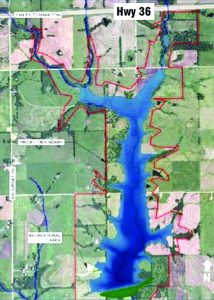
 Cathy Youtsey, chair of the Little Otter Creek Wholesale Water Commission, has been meeting with area public water supply districts to explore the possibility of making a connection to the Wholesale Water’s distribution system as a secondary or emergency supply of water for their customers. Recently, the Commission has met with Public Water Supply District #1 in Daviess County.
Ms. Youstsey believes the precaution is warranted.
“During the drought of 2012, water districts in our area got down to a 13-to-30 day water supply,” she said. “People don’t understand how serious that is. If that happens, if we run out of water, then there is no backup plan. Hundreds of square miles would be without water. You won’t be able to just open a faucet, or buy it, or ship it in. It’s just gone at that point. We need these reservoirs to withstand the droughts.
The Little Otter Lake project, located about three miles east of Hamilton, is being built to serve multiple purposes, like recreational opportunities and flood prevention. But mostly it is being built to satisfy the need for an adequate, dependable, locally-controlled, rural water supply.
The Little Otter Lake construction is directed by the Caldwell County Commission. The County Commission is a separate governing entity from the Wholesale Water Commission.
Ms. Youtsey explained that by state law, a county cannot be in the water business. That is, a county cannot process water, or sell and distribute finished water. A county can only sell raw water.
The Caldwell County Commission owns the property and will build Little Otter Lake and construct a dam. Caldwell County will then sell raw water from the lake to the Wholesale Water Commission. The Wholesale Water Commission will then be in charge of building a water processing plant and a distribution system that would sell water to its members.
As of this time there are five members (stakeholders) of the Wholesale Water Commission, which are PWSD #1 of Caldwell County, PWSD#2 of Caldwell County, PWSD#3 of Caldwell County along with the cities of Braymer and Hamilton.
The First Step: The Lake
The Little Otter Lake Project began in 1990. Not surprisingly, it was the summer of an extreme drought.
Much effort has gone into making the project a realization, including numerous government regulations and permits. Progress has been made and the lake is expected to break ground in about two years.
All of the property for the 345 acre lake has been purchased. Federal funding is in place. Revenue from a sales tax Caldwell County residents passed a decade ago will help pay for the construction. The county and its partners have accumulated $5.45 million toward the project. The Natural Resource Conservation Services (NRCS) added another $1.3 million through the Regional Conservation Partnership Program.
Only a couple of things remain to be done before Caldwell County can start digging its Lake —
An application for the Corps of Engineers for a 404 permit is being processed right now;
And the county is still awaiting approximately $4 million in state (matching) funding that has been approved by the legislature.
“The funding has been approved by the state legislature twice now; it’s what we need to make the Lake economically feasible for our county, rather than borrowing the $4 million,” said Ms. Youtsey. We have good support at the state level but those funds probably won’t be made available until the County receives its permits to construct the lake. It’s a process, from a, to b, to c. All of the major players are motivated and ready to go — the USDA, NRCS, Green Hills Community Block Development. The land itself has been bought and closed on. The engineering and design is complete. The funds are ready and available and as soon as they are approved and the 404 permit goes through, the county will ready to dig the lake and construct the dam.”
The Second Step: Water Plant and Pumping Station
Little Otter Creek Wholesale Water Commission was established to provide for the funding, financing, construction, acquisition, and operation of a wholesale water system in Caldwell County. That system includes a water treatment plant, distribution system and supply contract.
Funding for the Wholesale Water Commission to build the water plant cannot be applied for until the lake is a realty; that is, all the state and federal permits are approved, and construction of the lake has started.
The lake’s treatment plant will provide an estimated yield of 1.3 million gallons of water per day.
The Water Commission is in the process of finding out if the Reservoir can support and provide potable water for all the customers that would like to be included in LOCWWC.
“Little Otter Lake has X amount of potential,” said Ms. Youtsey. “The lake can only produce so many gallons. The Water Commission needs information from each district to determine who, where and what the demands are going to be. That information would include hydraulics, customer studies, etc. in order to proceed with an engineering study.”
Mrs. Youtsey believes the issue is important to the entire area, to all of Northwest Missouri, as there is not a district that doesn’t need upgrades and increased water.
“This is a vital project for this area,” she said. “Our water plants and our water systems, the reservoirs and wells are maxed out in age and capacity. The old reservoirs are silting in and the water tables are going down.”
 Cathy Youtsey, chair of the Little Otter Creek Wholesale Water Commission, has been meeting with area public water supply districts to explore the possibility of making a connection to the Wholesale Water’s distribution system as a secondary or emergency supply of water for their customers. Recently, the Commission has met with Public Water Supply District #1 in Daviess County.