Shadows will deepen, the sky will darken, the wind will grow still, and all nature will hold its breath—the total eclipse of the sun is said to be a beautiful and emotional spectral event that creates lifetime memories.
Some people think it’s fascinating, some think it’s creepy, and some just don’t care. Whichever way you feel about it, the total eclipse will be here at around 1 p.m. on Monday, Aug. 21.
The path of totality is a 60 to 70 mile wide path that spans from coast to coast across the United States, from Oregon to South Carolina; 14 states will be touched. South Carolina will see the biggest impact because it is the closest destination for the Eastern Seaboard, but Missouri, Tennessee and Oregon are expected to have major impacts.
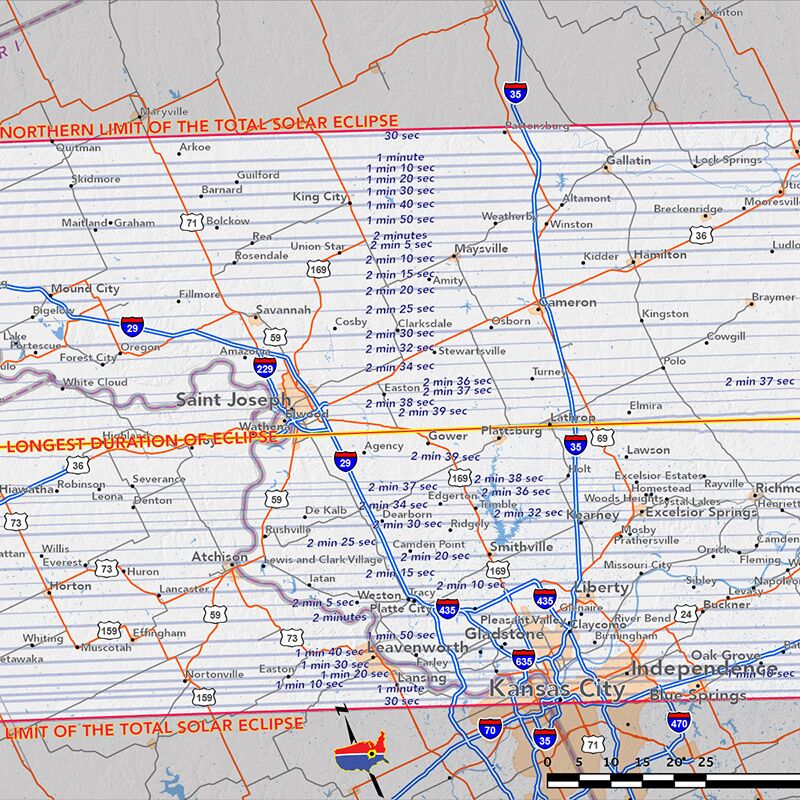
“Unfortunately — or fortunately — Gallatin is near the northern edge of totality,” noted Michael Zeiler of greatamericaneclipse.com, one of the premier informational websites to keep the public ahead of this unique experience. “Your residents should stay and enjoy the spectacle, but most eclipse visitors will drive a bit south to get maximum duration of totality.”
Mr. Zeiler said Gallatin will get one minute and 14 seconds of totality. On the centerline to our south, the maximum duration will be two minutes and 40 seconds.
Many of the eclipse watchers will camp out with sleeping bags and tents, others will be in RVs. Andrean Warner, owner of the Sandman Motel in Gallatin, said she has had only a couple of in-state inquiries so far regarding the eclipse.
It seems Gallatin may be in a perfect spot to view the eclipse and to do so in relative peace.
A public eclipse viewing party has been organized by the Daviess County Library on the courthouse lawn. Gallatin Police Chief Mark Richards said his department will be working in conjunction with the library for the viewing on the Gallatin square. The event will be treated in much the same way as Chautauqua as far as crowd control and blocking off areas and roadways.
“We’ll have water and first aid available if there are any problems,” Chief Richards said. “If it’s hot, we’ll want to watch for heat exhaustion, dehydration, things like that.”
Travelers on the road are advised to be vigilant for drivers who are distracted or attempt to pull over during the two minutes of the eclipse.
“Gallatin will be a good viewing area for the eclipse, but not a prime viewing area,” Chief Richards said. “We expect to have a crowd in town because of the public activities being offered, but we don’t expect thousands like St. Joe is expecting.”
The only thing that can obstruct the fun is the clouds. Hope for a clear day for viewing.
The next total solar eclipse won’t be until April 8, 2024, and it will go through a different set of states.
Here is some information from the greatamericaneclipse.com.:
- A total eclipse of the Sun occurs when the Moon gets between the Sun and the Earth and covers up the Sun. It just so happens that the Moon, as seen from Earth, and the Sun, as seen from Earth, are the same size in the sky. So if the two are exactly lined up, the Moon can hide the Sun from our sight. This allows us to see the Sun’s corona (outer atmosphere).
- Some 12.25 million live inside the path of totality for the 2017 Eclipse.
- Between 1.85 and 7.4 million are expected to visit the path on eclipse day.
- The population of Missouri is 31,200,000 and on eclipse day may swell by anywhere from 322,000 to 1,290,000 — and this does not include the people who already live within the path.
- The total phase in 2017 will last a maximum of 2 minutes 40 seconds in the center of the Moon’s shadow.
- Only Indonesia and a few islands in Micronesia experienced totality on March 9, 2016.
- The center line of the total eclipse really doesn’t go through any of America’s largest cities. It will be visible from Nashville and parts of the St. Louis and Kansas City metropolitan areas.
- The Sun’s visible (and invisible) rays can cause serious damage to the sensitive tissues of the eyes, often without one being immediately aware of it!
- PICTURE: Michael Zeiler of Great American Eclipse website provides detailed maps where each highway meets the centerline of eclipse. Pictured is the map of St. Joseph. Notice that Lathrop is smack dab on the line.

 Shadows will deepen, the sky will darken, the wind will grow still, and all nature will hold its breath—the total eclipse of the sun is said to be a beautiful and emotional spectral event that creates lifetime memories.