
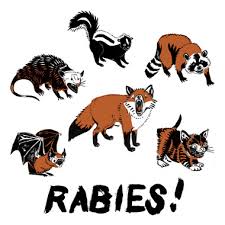
 Are you aware, all animal bites are reportable to the Daviess County Health Department for disease investigation? The reason is because of the potential of rabies in animals that can be spread to humans through a bite exposure. In the summertime, the Health Department sees an increase in reports and investigations of rabies exposure because we humans are out and about enjoying our summer and so are animals.
This website brought to you in part by the following sponsor:

Find out how to advertise here - Email us! [email protected]
In a perfect world all animals would be fully vaccinated and on a leash with their owner, but as we know that is not the case at all. We certainly don’t have control of wild animals in any way. So with that said, there are some ways to protect yourself and your animals from rabies:
If you or a family member is bitten by ANY animal, report it to the police immediately and seek appropriate medical care.
Do not kill the animal that has bit, unless you have to protect yourself. The animal will be quarantined or euthanized and submitted for testing. If the animal is killed and unavailable for testing, the recommendation is to vaccinate the victim with rabies vaccine depending on circumstances.
Do not approach stray or wild animals.
Call the police or animal control if there is an animal in your yard or running loose in the streets.
Keep your pets vaccinated against rabies.
Keep your animals on a leash, in a fenced area or under direct supervision.
Rabies is a preventable viral disease of mammals most often transmitted through the bite of a rabid animal. The vast majority of rabies cases reported to the Centers for Disease Control and Prevention (CDC) each year occur in wild animals like raccoons, skunks, bats, and foxes.
The rabies virus infects the central nervous system, ultimately causing disease in the brain and death. The early symptoms of rabies in people are similar to that of many other illnesses, including fever, headache, and general weakness or discomfort. As the disease progresses, more specific symptoms appear and may include insomnia, anxiety, confusion, slight or partial paralysis, excitation, hallucinations, agitation, hyper salivation (increase in saliva), difficulty swallowing, and hydrophobia (fear of water). Death usually occurs within days of the onset of these symptoms.
All species of mammals are susceptible to rabies virus infection, but only a few species are important as reservoirs for the disease. In the United States, distinct strains of rabies virus have been identified in raccoons, skunks, foxes, and coyotes. Several species of insectivorous bats are also reservoirs for strains of the rabies virus.
Transmission of rabies virus usually begins when infected saliva of a host is passed to an uninfected animal. The most common mode of rabies virus transmission is through the bite and virus-containing saliva of an infected host. Though transmission has been rarely documented via other routes such as contamination of mucous membranes (i.e., eyes, nose, mouth), aerosol transmission, and corneal and organ transplantations. For further information about rabies, log onto rabies virus cdc.gov/rabies/transmission/virus.html.