

A hawk of the woodlands, often heard before it is seen. The clear whistled calls of this hawk are conspicuous, especially in spring; in the east, Blue Jays often give a near-perfect imitation of this call. Over much of eastern North America the Red-shoulder has become uncommon, sticking closely to the remaining forests. Populations in Florida and California are often more visible, perhaps adapting better to open habitats. Photo Carol Fryer, Audubon field guide.
This website brought to you in part by the following sponsor:

Find out how to advertise here - Email us! [email protected]
The Audubon Christmas Bird Count is the longest-running citizen science survey and is conducted by the National Audubon Society. The count provides ornithologists with a crucial snapshot of our native bird populations during the winter months.
Despite the setbacks, the Grand River birdwatchers still mustered a very good count of 68 species. That’s just four species short of its record of 72 species counted in 2012. A total of 6,073 individual birds were tallied for the day.
“This is down slightly,” noted Mr. McNeely, who has been the Grand River Audubon compiler and participant for the last 26 years. “I attribute some of this to fewer eyes in the field.”
Each individual count is performed in a count circle with a diameter of 15 miles. The volunteers break up into small parties and follow assigned routes, which change little from year to year, counting every bird they see.
Some of the most unusual birds observed and counted by the Grand River Audubon Society were:
Brewers Blackbird, Wilson’s Snipe, Killdeer, Lapland Longspur, Snow Bunting, Red Shouldered Hawk (a first for the count), Winter Wren, Field Sparrow (a summer resident).
A record high number for three species seen included: Hermit Thrush – 11, Yellow-rumped Warbler – 15, and Purple Finch – 81.
Bald Eagles were plentiful with 22 tallied.
“That’s a large leap from the first few years when we could only find one to three Bald Eagles,” Mr. McNeely stated. “The snow helped with the Northern Bobwhite (Quail) tally of 80 birds.”
The Society found all six species of Woodpeckers in good numbers. Also 10 species of sparrows were found. This does not include the House Sparrow, which does not fall into the same family as the native sparrows.
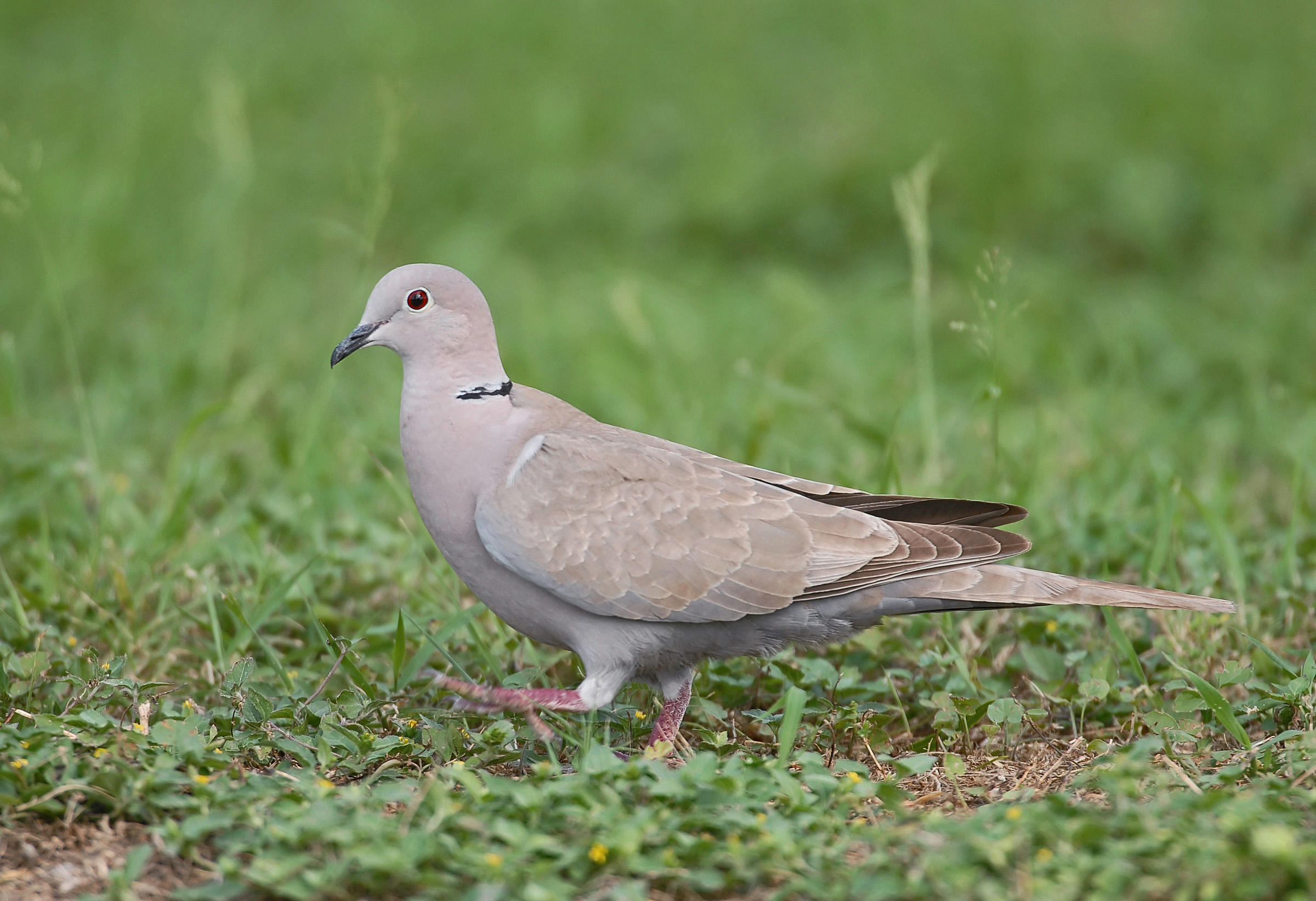
During the 20th century, this pale dove expanded its range spectacularly from the Middle East all the way across Europe. Introduced accidentally into the Bahamas in 1974, it soon spread to the Florida mainland. Its expansion westward and northward from there since the 1980s has been remarkable, and the species is now common to abundant across much of North America, as far northwest as Oregon and Washington. Oddly, the expansion has not yet penetrated the northeastern states, aside from a few records of strays. Photo Rob Curtis, Audubon field guide.
The House Sparrow is showing a major decline as the years have gone by. This year the group tallied 177 House Sparrows. In 1989, they tallied 1,908, the highest count ever. Mr. McNeely believed some of the cause for the decline is the loss of many small farm feedlots in the Grand River Audubon circle. The birdwatchers also noticed that not as many House Sparrows are being seen in the towns that the group covers.
“The Eurasian Collared Dove numbers are increasing each year,” Mr. McNeely said. “They only started to appear on our count 10 years ago, and were usually found around grain elevators, but over the years their sightings become more uniform in our count circle.”
Audubon is a nonprofit conservation organization. Learn more at www.audubon.org and follow @audubonsociety.
To sign up for next year’s Grand River Audubon count, contact Terry McNeely at (660) 828-4215.