
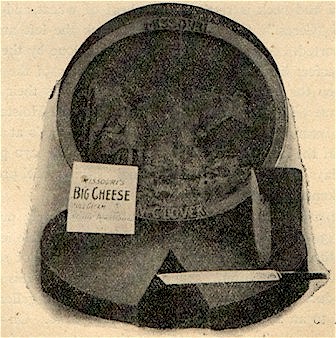
 Altamont’s “big cheese” had become the stuff of legends, but it’s not a myth. Several historical records confirm the big cheese exhibit at the 1900 World’s Fair, which was held in September.
This website brought to you in part by the following sponsor:

Find out how to advertise here - Email us! [email protected]
Missouri State University has an Agricultural History Series that reported about the “Big Cheese” as follows:
Missouri’s cheese exhibit was a one of a kind display of a full cream cheese block that weighed over 3,000 pounds. The block was so massive it took 10 men to unload it from the train into a case, and four horses hitched to a wagon with the case to pull it to the agriculture building. The cheese was made in Altamont, Mo., in Daviess county. Molded to the front of the cheese was a milking cow in a pasture of clover with a young lady on a stool milking the cow. It took 3,000 milking cows to produce the 35,000 pounds of milk, which was purchased from 150 dairymen, needed to make the block of cheese. The cheese was displayed in the original hoop that it was pressed in, in a case that was exactly like the butter case, and the temperature was held from 35 to 40 degrees.
Another source, THE CHEESEMAKER records the scores awarded at the World’s Fair Competition in St. Louis, Mo., in 1904. Scores of 90 and over were awarded to the cheese exhibits —
J.L. Musselman of Altamont received a score of 90 under FLATS;
R.T. MCcoskey of Altamont received a score of 90 under DAIRIES.
The scores were apparently out of a possible 100. This is recorded in volume 18 on page 926.
THE CHEESEMAKER was a trade magazine for dairy producers. Articles were collected in a book called the New York Produce Review and American Creamery. The book covers 26 issues of THE CHEESEMAKER from May 4, 1904, to Oct. 26, 1904.
On page 960 of the same book, there’s a little more about the subject, under Cheese Exhibits. The weight of the cheese differs from the MU site’s version. It reads as follows: Missouri — Her main exhibit is the big full cheese made at Altamont, Daviess County. It is about six feet in diameter and weighs 1,500 pounds. There is also a scene of a man sitting on a three legged stool milking a cow. Close by is the suggestive sign that both the cow and the farmer are in clover.
The 1900s were good, productive years for the area. There were about three times as many people living in the county and the railroads shipped people and products through every small town. Here are some other facts about Daviess County. This was taken from the Missouri Department of Labor and Industrial Inspection from the year 1900 (Volume 23 page 183)
Daviess County
Present population 21,325
Surplus Products Shipped in 1900
Cattle, head 9,920
Hogs, head 42,826
Horses and mules, head 1,660
Sheep, head 4,810
Rye, bushels 1,322
Hay, pounds, 1,108,000
Flour, pounds 147,291
Ship stuff, pounds 23,020
Timothy seed, pounds 2,640
Millet seed, pounds 98,315
Apples, barrels 490
Hardwood lumber, feet 81,000
Walnut logs, feet 99,000
Fence and mine posts 1,050
Cordwood, cords 168
Cooperage, cars 7
Stone, cars 2
Junk, cars 7
Poultry, dressed, pounds 213,188
Poultry, live, pounds 735,550
Eggs, dozen 922,430
Butter, pounds 241,125
Cheese, pounds 1,965
Peaches and plums, baskets 5
Fresh fruit, pounds 4,380
Dried fruit, pounds 1,305
Dressed meat, pounds 4,790
Game, pounds, 4,095
Fish, pounds 859
Furs, pounds 1,703
Feathers, pounds 2,637
Hides and pelts, pounds 48,115
Lard, pounds 660
Tallow, pounds 6,655
Cider, gallons 100
Vinegar, gallons 110
Molasses, gallons 167
Vegetables, pounds 2,500
Canned goods, pounds 280
Tobacco, pounds 765
Wool, pounds 30,236
Nuts, pounds 3,940
Broomcorn, pounds 20,000
Location and Resources: In northwestern part of State, about 50 miles northeast of St. Joseph. Its railroads are the Wabash, Q., O. & K.C., and the C., R. I & P. About 10 percent of the area is in timber, the chief varieties being oak, elm, hickory and walnut. The county contains limestone, sandstone and brick clay.
Manufactures: Flouring mills are operated at Gallatin, Jameson, Jamesport and Lock Springs; one each of lime, brick and cigar factories at Gallatin; combination saw mill, handle and cooperage works at Magill; cigar factory at Jamesport and cheese factories at Altamont and Winston.
New Enterprises Desired: Jamesport will offer substantial encouragement to a first-class flouring mill. Creameries and canning factories could be sustained at several points in the county.
Average Wages Paid: Carpenters, $2 per day; plasterers, $2.25 per day; painters, $1.75 per day; brick and stone masons, $2.50 per day; blacksmiths, $2 per day; printers, $1.25 per day; farm hands, $16 per month; household help, $2 per week.
Population of Incorporated Towns:
Altamont 288
Bancroft 50
Coffeeburg 390
Gallatin 1,780
Jackson 172
Jameson 335
Jamesport 728
Rockspring 246
Pattonsburg 1,065
Winston 457.
Rocksrping was probably a misspelling of Lock Springs.
Definition of ship stuff: 1: a low-grade wheat flour with high bran content; 2: wheat offals that are used as a stock feed.
Definition of cooperage: 1: a cooper’s work or products; 2: a cooper’s place of business.
Definition of cooper: : one that makes or repairs wooden casks or tubs.
Definition of Timothy Seed: Timothy is a grass seed used mainly for hay, but also for pasture and silage.